11 Nov 2026
Every autumn, fireworks season creates a predictable crisis for pet owners across the UK. Displays begin in late October, intensify around Bonfire Night on 5 November, and often continue through Diwali and into the new year. For the animals in your household, this extended period of unexpected loud noises is not a minor inconvenience — it is a genuine threat to their safety, triggering panic responses that can send even the most placid dog over a garden fence they would never normally approach. Preparation is everything. This guide covers what you need to do before the season starts, what to do on the night, and — critically — how to make sure that if your pet does bolt, they can be found and returned quickly.
Why Fireworks Affect Animals So Severely
Dogs, cats, and many other domestic animals have hearing ranges considerably wider than ours. Where an adult human can detect sounds up to approximately 20,000 Hz, dogs hear up to 65,000 Hz and cats up to 79,000 Hz. Fireworks produce noise across a broad spectrum — including frequencies above the range of human hearing — and at sudden, unpredictable intensities. The combination of high volume, high frequency, and random timing triggers the same threat-response in a domestic animal that a predator attack would trigger in a wild one: fight, flight, or freeze.
For most domestic pets, flight is the dominant response. A dog that hears a firework overhead may bolt with no warning, clearing obstacles and travelling distances that would be impossible under normal circumstances. Adrenaline suppresses pain and fatigue in a panicking animal — a dog that would never attempt a garden fence may clear it with ease, and may run for miles before the adrenaline subsides. By that point, the animal is exhausted, frightened, and lost in an unfamiliar area.
Cats, though more associated with hiding than bolting, can also run in panic and become genuinely lost. An indoor-outdoor cat that is outside when fireworks begin may flee far enough to lose its bearings completely. A cat that has always found its own way home may not be able to do so after a panic flight covering unfamiliar ground.
Rabbits deserve specific mention because they are often forgotten in discussions about fireworks and pets. Rabbits can die from extreme fright — cardiac arrest triggered by shock is a documented cause of death in rabbits exposed to fireworks. They cannot be calmed by human company in the way dogs can, and their outdoor hutches provide no protection from either the sound or the visual flashes of nearby displays.
The Risk Window Is Longer Than Most People Realise
Bonfire Night on 5 November is the centrepiece of the UK fireworks season, but it is not the only evening on which pet owners need to be prepared. In practice, fireworks are used at organised and informal displays throughout a period of several weeks, and the pattern extends beyond autumn into winter.
The key dates to be aware of:
- Late October: Informal displays in the days before Halloween. Halloween itself has become associated with outdoor celebrations that sometimes include fireworks.
- Early November: Organised Bonfire Night displays, which local councils and private organisers spread across the nearest weekend to 5 November, sometimes extending the effective display period to three or four evenings.
- Diwali: Falls in October or November depending on the lunar calendar, and involves significant fireworks use in communities across the UK. The date varies each year.
- New Year's Eve and midnight: Often the most intense single moment for noise, with fireworks used at midnight in many towns and cities.
- Sporting events and celebrations: Local championship celebrations, weddings held at venues with display licences, and community events can produce fireworks at unpredictable times throughout the year.
Treating only the evening of 5 November as a risk period means you are unprepared for several weeks of potential stress either side of it. The preparation steps below are worth implementing from mid-October and keeping in place through to the new year.
The Most Important Preparation Step: Check Your Pet's ID Now
Before the season begins, check that your pet's identification is current and complete. This single step is the most important thing you can do to ensure that a panicked pet that does bolt has the best possible chance of coming home quickly.
Microchip registration must be current. If your dog or cat is microchipped — which is a legal requirement for dogs in the UK and for cats in England since June 2024 — verify that the contact details on the chip's database registration are accurate. An old phone number or a previous address on the registration can delay or prevent reunification entirely. You can check your pet's registration status at check-a-chip.co.uk. If the details are wrong, contact the relevant database directly and update them. This takes about five minutes and costs nothing.
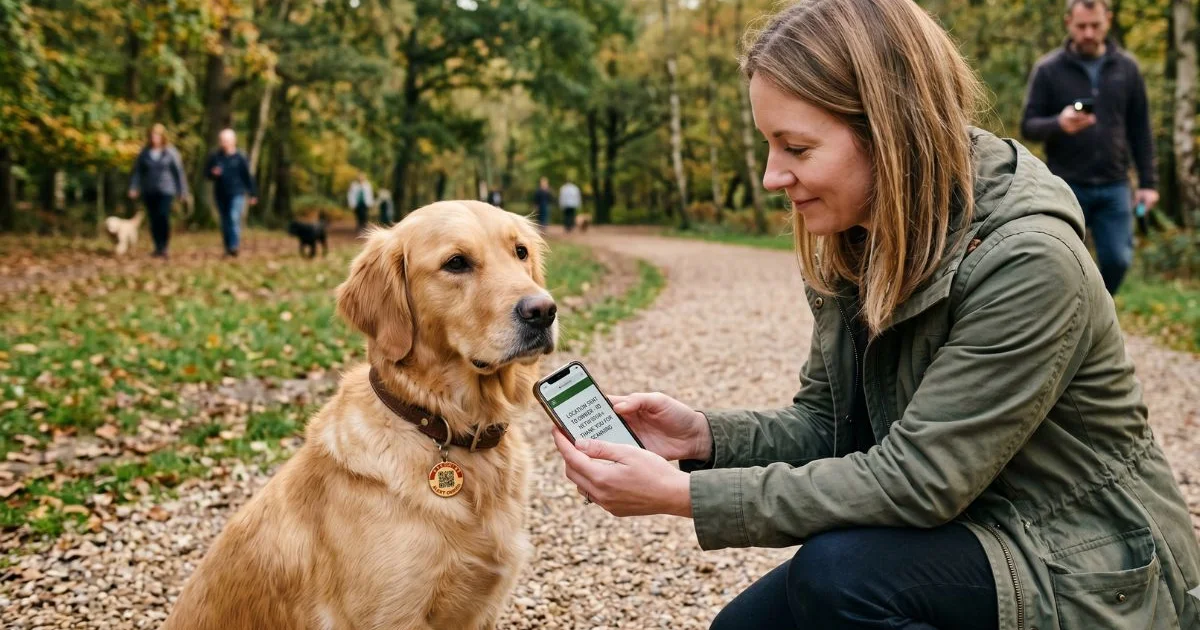
Consider whether your pet has visible, current collar ID. For dogs, the Control of Dogs Order 1992 requires a collar tag bearing the owner's name and address in any public place — and a dog that bolts in a panic is very much in a public place. An engraved tag with a current phone number is the minimum. As this guide explains, an engraved tag does carry a privacy trade-off: your personal details are visible to anyone who reads it. A QR tag addresses this by allowing any finder to contact you immediately through a private message system, without seeing your phone number or home address.
Why Fireworks Season Is the Right Time to Add a QR Tag
A QR pet tag is useful all year round — but fireworks season is when the gap it fills is most acute. During normal weeks, a lost dog is typically picked up by someone who knows what to do, taken to a vet for a microchip scan, and returned through the official system within a day or two. During Bonfire Night weekend, vets and dog wardens are inundated. The official system slows down precisely when more pets are going through it simultaneously.
A QR tag bypasses this bottleneck entirely. If your dog is found by a neighbour, a park visitor, or a driver who stops on a road at 10pm on November 5th, that person does not need to find an open vet, call a warden, or navigate a lost-pet database. They scan the tag with their phone camera, send a message, and you receive a notification on your phone within seconds. You can arrange immediate collection.
The time between a pet bolting and a finder making contact is the most stressful period for any pet owner. A QR tag compresses that window as much as anything practically can. Getting one before the season starts, rather than after a crisis, is the definition of useful preparation.
Creating a Safe Space Before the Displays Begin
A safe space is a designated area in your home where your pet can retreat when frightened. For dogs, this is typically a crate, a bed in a corner, or a spot under a desk that the dog already associates with rest and security. For cats, a favourite hiding spot — under a bed, in a wardrobe, behind a sofa — serves the same purpose. The key is that the space is the animal's own choice and association, not somewhere you put them against their will.
Set up the safe space in advance and encourage your pet to use it in the weeks before the season. Feed them near it. Put familiar blankets or unwashed clothing with your scent in it. Allow them to retreat there voluntarily whenever they choose. By the time fireworks begin, the space should already feel genuinely safe to the animal — not a novel environment they are being pushed into during a crisis.
Position the safe space as far from windows and exterior walls as possible. Interior rooms on upper floors muffle sound somewhat; rooms at the back of the house away from the street typically experience fewer firework flashes through the windows. Draw curtains or blinds before displays begin to reduce the visual stimulation of the flashes.
Keeping Cats In During the Season
For cats that have outdoor access, the period from late October through early November warrants keeping them in after dark — or in some cases through the whole day if displays are planned in the daytime. A cat that is indoors when fireworks begin cannot bolt into danger. A cat that is outdoors when they begin may cover a significant distance before finding anywhere it feels safe.
This involves adjusting your cat's routine in advance. If your cat is used to going out in the evening, start keeping them in at dusk from mid-October onwards, so the change is gradual rather than sudden. Ensure the litter tray is clean and accessible. Provide additional indoor enrichment — food puzzles, toys, window perches — to compensate for the reduced outdoor time.
Check that all windows, doors, cat flaps, and potential escape routes are secured before dark on evenings when displays are expected. A cat that pushes through an insecure cat flap during a panic is a cat that is now outdoors in a fireworks environment.
Dogs: The Evening Routine on Display Nights
Walk your dog earlier than usual on Bonfire Night and on any evening when displays are planned. A dog that has had a full walk and is physically tired is better placed to settle in the evening than one that is restless from unspent energy. Check your local council's website and social media accounts — many councils publish the dates and approximate times of organised displays in advance.
Feed your dog before the display rather than during it. Anxiety suppresses appetite in many dogs, and a dog that is in a panic is unlikely to eat normally. A settled pre-display meal gives the evening a sense of normalcy and ensures the dog is not hungry on top of being stressed.
Do not leave your dog alone during displays if you can avoid it. Your presence is genuinely reassuring to most dogs — the idea that comforting a frightened dog reinforces fear is not supported by current veterinary behavioural evidence. Sit with your dog, remain calm yourself, and allow the dog to seek closeness if it wants to. Your calm is contagious in the same way that your anxiety would be.
Background noise — a television, a radio, or white noise specifically — can help mask the sound of fireworks. The masking effect is partial, not complete, but it reduces the startling contrast between the indoor silence and the sudden outdoor bang. There are sound therapy recordings specifically designed for this purpose, which introduce the types of sounds that trigger anxiety at very low volume over a period of weeks, helping to gradually reduce the sensitivity response.
Recognising Extreme Anxiety and When to Seek Help
Most dogs and cats will show some degree of stress during fireworks. This is normal and manageable. The signs to watch for that suggest the level of anxiety warrants veterinary attention:
- Sustained trembling or shaking that does not diminish over time
- Excessive salivation or panting that persists for more than an hour after noise has stopped
- Self-harm — excessive licking, scratching, or biting that draws blood
- Complete inability to settle, constant pacing, or attempts to escape that are causing injury
- Collapse, loss of bladder or bowel control, or apparent confusion
If your pet's anxiety is severe, speak to your vet before fireworks season begins. There are prescription medications, pheromone diffusers, and supplement-based approaches that can reduce the physiological severity of the stress response. These work better when started before the season rather than during it — a vet consulted in October can prepare a management plan; one called on the evening of November 5th has fewer options.
Rabbits and Small Animals
Rabbits, guinea pigs, and other small animals kept in outdoor hutches are among the most vulnerable to fireworks-related harm, and among the most often overlooked in fireworks guidance aimed primarily at dog and cat owners. If possible, bring outdoor hutches or enclosures inside for the duration of the fireworks season — a garage, shed, or utility room provides significant sound dampening even if it is not fully silent.
If bringing the enclosure inside is not practical, cover it with thick blankets or duvets on display evenings to muffle sound and block the visual flash of fireworks. Leave a gap for ventilation — covering all sides completely will overheat the animal. Ensure the cover is weighted or secured against wind.
Rabbits that show signs of shock — lying on their side, rigid limbs, rapid shallow breathing, unresponsiveness — need emergency veterinary attention. Do not wait to see if they recover. A rabbit in shock is a medical emergency.
Horses and Livestock
Horses are particularly vulnerable to fireworks because they are typically kept in open fields where sound and visual stimulation are unmitigated, and their flight response is powerful enough to cause serious injury to themselves, fencing, and anyone nearby. If you keep horses and are aware of a nearby display, consider stabling them for the evening rather than leaving them in the field. Inform your local council's licensing department of your concerns if an organised display is planned near land where horses are kept — in some cases, the date or time can be adjusted.
If stabling is not possible, ensure fencing is sound and that the horses have adequate hay and companion animals (horses are herd animals and are more settled with others present). Notify a trusted person who can check on them during the display.
If Your Pet Bolts: The First Thirty Minutes
Despite all preparation, pets do bolt. If yours does, the first thirty minutes determine a great deal. The key principle is to act immediately and broadly rather than searching alone.
Do not wait to see if the pet returns on its own. Some do; many do not. As soon as you realise the animal has escaped, take simultaneous action on several fronts:
- Search the immediate area. A panicking animal that has escaped will often run fast initially but then hide nearby — under a car, in a bush, behind a garden wall. Check close to your home first, moving quietly rather than calling loudly, which may frighten an already panicking animal further away.
- Alert your neighbours immediately. Knock on doors, send messages, post on your local WhatsApp group or Nextdoor. Neighbours who know to watch out for your dog have many more eyes than you searching alone.
- Post on local Facebook groups. A lost-pet post in the right group reaches hundreds of local people immediately. Include a photograph, description, colour, and area. Do this even if you are still hoping the pet will return on its own — the sooner the alert goes out, the sooner people are looking.
- Report to the dog warden. If it is during council operating hours, call the dog warden service. Out of hours, many councils have emergency contacts for stray dogs — check your council's website. The warden's log means that if someone hands in the dog, you will be matched to it.
- Contact local vets. Call practices in your area and in adjacent areas. Finders often take frightened animals to the nearest vet for a microchip check before doing anything else.
If your pet has a QR tag, post the tag's unique URL in your search updates — it means anyone who finds your pet and scans the tag will reach you directly. On a busy Bonfire Night, when lost pet posts are coming in from many owners simultaneously, having a direct scan-to-contact mechanism working in parallel with your social media search increases your chances of a quick reunion significantly.
After the Season: Long-Term Desensitisation
If your pet had a severe response to fireworks this year, the time to address it is now — not in October of next year. Behavioural approaches to fireworks anxiety, particularly gradual sound desensitisation, work best when started months in advance and practised consistently over time.
The approach involves introducing recordings of fireworks sounds at very low volume while the animal is in a relaxed state, gradually increasing the volume over weeks and months as the animal's tolerance builds. The goal is to break the association between the sound and the panic response through gradual, controlled exposure. This requires patience and consistency, and it works significantly better for some animals than others — but for dogs with severe anxiety, it can transform the fireworks experience over one or two seasons.
Your vet or a certified veterinary behaviourist can advise on whether a sound desensitisation programme is appropriate for your animal, and whether medication support should be used alongside it. Both together typically produce better outcomes than either alone for severe cases.
The Legal Landscape Around Fireworks in the UK
Private individuals in the UK can legally purchase and use Category F2 fireworks — those permitted for garden use — without a licence. Category F3 and F4 fireworks are restricted to professional operators. The sale of fireworks to the public is limited by law: in England and Wales, shops may sell to the public without a specific licence only in the three days before Bonfire Night, three days before Diwali, and three days before Chinese New Year and New Year's Eve. Outside these periods, only licensed retailers may sell.
Time restrictions on private use are enforceable: in England and Wales it is an offence to set off fireworks in a public place, and private use is restricted to before 11pm on most nights, before midnight on Bonfire Night itself, and before 1am on New Year's Eve and Chinese New Year's Eve. Fireworks set off after these hours in a residential area can be reported to the local environmental health department, which has powers to issue noise abatement notices to repeat offenders.
If a neighbour's private display is causing significant distress — to your animals, your children, or household members with medical conditions affected by noise — a polite conversation with the neighbour before the season begins is usually more effective than a formal complaint after the event. Most people using garden fireworks are not aware of the full effect on nearby animals and adjust their plans when they understand the impact.
Helping Neighbours' Pets During Fireworks Season
Your own pets are the priority — but fireworks season is also a time when awareness of animals belonging to nearby households can make a practical difference. If you know that a neighbouring household has an anxious dog or a cat that bolts at loud noises, a brief note or message before the 5th of November allows them time to take precautions they might not otherwise have prepared.
If you are planning your own garden display, giving immediate neighbours advance notice of the approximate time is a considerate habit that costs nothing. A few minutes' warning allows people to bring pets inside, settle animals, and close windows before the first firework goes up.
In the days following Bonfire Night, keep an eye on local community groups and noticeboards for lost-pet appeals. A dog that bolted on the 5th may still be missing a week later, and a post shared from your network may be the thing that reaches the person who found the animal. Community action — neighbours watching out for each other's animals — is consistently one of the most effective factors in reuniting a lost pet with its owner. It requires no specialist knowledge and costs nothing beyond a moment's attention.
Thunder, Loud Events, and Year-Round Noise Anxiety
The preparation described throughout this guide for Bonfire Night applies equally to other sources of sudden loud noise that affect animals throughout the year. Thunder is the most common equivalent — a storm arriving overnight produces the same panic response in an anxious dog as a fireworks display, with considerably less predictability. Gun shots from rural shooting activity, pneumatic construction equipment nearby, low-altitude aircraft, and crowd noise from outdoor events are further regular triggers.
For animals with severe generalised noise anxiety — anxiety triggered regularly throughout the year rather than only at predictable seasonal events — a veterinary behavioural assessment is worth pursuing. Noise anxiety that significantly affects an animal's quality of life, causes self-harm, or produces escape behaviour on a regular basis is a welfare issue that medication and structured behavioural therapy can substantially improve. It is not simply a personality trait the animal must learn to endure.
The identification preparation this guide recommends for Bonfire Night — current microchip registration, current collar ID, QR tag — is equally important for animals with year-round noise sensitivity. A dog that escapes during a July thunderstorm needs the same immediate identification mechanism as one that bolted during a November display. Treat the ID check as annual maintenance rather than a seasonal task, and your pet is better protected regardless of when the next crisis occurs.
A Short Checklist for the Season
Before each fireworks season, running through this list takes under thirty minutes and addresses every identification gap that could slow down reunification:
- Check the microchip registration at check-a-chip.co.uk — confirm that your name, current phone number, and address are all accurate on the database.
- Inspect the collar tag — is the phone number still legible? Is the tag worn smooth enough that it would be difficult to read in poor light? If so, replace it.
- Check any QR tag account — if you use a QR tag service, log in and confirm that the contact details linked to the tag are current. Update a phone number if it has changed since you last logged in.
- Brief any carers. If your pet will be looked after by a house-sitter or neighbour during the fireworks period, make sure they have the chip number, the tag details, and the dog warden contact for your area saved in their phone.
- Save the dog warden number for your local authority before you need it under pressure on a busy November evening.
Prepare Now, Before the Crisis
The pattern with fireworks season is that it catches pet owners unprepared every year. The displays are predictable. The dates are known. The risk to animals is well-documented. Yet the lost-pet reports that flood local Facebook groups every November 5th come largely from owners who had not updated their microchip registration, who had not checked their pet's collar tag, and who had not thought about what would happen if their animal bolted.
The week immediately after Bonfire Night is also worth monitoring closely. A dog or cat that escaped during a display may have been taken in by a neighbour who has not yet posted about it, or may have sheltered somewhere before emerging days later when the panic has subsided. Check local lost-and-found pages, Doglost, Animates, and community Facebook groups not just on the night itself but every day through the following week. Post a "missing" notice with a clear, recent photograph as soon as the animal is confirmed missing — do not wait until morning if you know the animal ran during the evening. Every hour in the first twelve matters. Sharing the post in breed-specific Facebook groups and neighbourhood apps like Nextdoor can significantly extend the reach of a lost-pet notice beyond what a single social media post would achieve alone.
Preparation takes an hour, most of it at a computer: check the microchip registration, verify the collar tag information, and if you have not already got a QR tag on your pet's collar, get one before the season starts. The difference between a pet that is home within an hour of being found, and one that spends two days in a council kennel before the owner is tracked down, is often nothing more than current, accessible ID.
If you would like to get a QR tag for your pet before Bonfire Night, browse HeyOwner's pet tag options here. Every tag links to a private contact page that any finder can reach with a standard smartphone camera — no app, no account, and no personal details exposed. A scan, a message, and your pet is coming home.