11 Nov 2026
Finding someone's keys or wallet is one of those small moments that carries a surprising amount of moral weight. You have picked up something that matters enormously to the person who lost it — their keys may be locking them out of their home right now, their wallet may contain their only bank card, their driving licence, cash they cannot afford to lose. Your instinct is to help. But how, exactly? Handing found property back sounds simple until you try to do it in practice. There is no name on the keys. The wallet has a driving licence but no phone number. And even when you do find a way to trace the owner, you may not want to give a stranger your home address in the process. This guide covers the practical, legal, and personal dimensions of returning found keys and wallets in the UK — and explains why a QR key fob makes most of this complexity disappear.
Your Legal Position as a Finder in the UK
The legal position of someone who finds lost property in England and Wales is often misunderstood. There is no general legal duty to hand in found property to the police, contrary to what many people believe. However, keeping found property with the intention of permanently depriving the owner of it can constitute theft under the Theft Act 1968 — specifically, the offence of "theft by finding." The test is whether you made reasonable efforts to find the owner. If you found a wallet, kept the cash, and threw the rest in a bin without making any attempt to return it, that would likely satisfy the test for theft. If you found a wallet, tried every reasonable channel to find the owner, and ultimately kept it when those efforts were exhausted, the legal position is very different.
In Scotland, the law is slightly different. The Civic Government (Scotland) Act 1982 imposes a more explicit obligation to take reasonable steps to find the owner of found property, and in some cases to hand the property to a constable. The practical guidance — make genuine efforts to find the owner — is the same in either jurisdiction.
The important takeaway is that you are not legally required to hand found keys or a wallet to the police in England and Wales, though doing so is often the most practical option when you have no way of identifying the owner yourself. What you are required to avoid is the dishonest appropriation of someone else's property.
Context Matters: Where Did You Find It?
Before you decide on your next move, consider where you found the item. The context shapes almost everything about your options.
If you found the keys or wallet in a café, pub, restaurant, shop, or any other commercial premises, hand it in to the staff immediately. Most venues have a simple lost property system, and returning to collect it is typically the first thing a person does when they realise something is missing. The item is far more likely to reach its owner through this route than if you take it away with you. Ask for the venue's name, phone number, and address so you can follow up if needed. Note: taking an item home from a venue, rather than handing it to staff, places the burden entirely on you to make it available for collection — and the owner may not know who to contact.
If you found the item on public transport — on a bus, train, tube, or at a station — the transport operator's lost property office is the right destination. Transport for London, for example, runs a well-staffed lost property office and reunites thousands of items every year. National Rail operators have their own lost property systems. These offices are specifically designed for exactly this situation. Report the item to the relevant operator promptly, since unclaimed items move through the system over time.
If you found the item on the street, in a park, or in any public space with no obvious venue to hand it in to, the options are wider and require more thought on your part.
Found Keys With No Identification
A set of keys with no tag, no label, and no identifiable information attached is among the most frustrating found-property situations there is. There is often no way to identify the owner at all. The keys may open a house, a car, a bicycle lock, or all three — but without an address or a name, you have no obvious starting point.
Your realistic options in this situation are limited but not non-existent. Consider the following:
- Return to the spot where you found them. If you found the keys on the ground near a specific address, the owner may live or work there. Knock on doors if it seems reasonable to do so. A set of house keys found outside a terraced house in a quiet street is probably from one of the five nearest houses — a quick check may resolve the situation in minutes.
- Hand them in to the nearest police station or police lost property point. A person who has lost their keys will often check with local police as one of their first actions. If you hand in keys and they contact the police to report them lost, they may be matched to your submission.
- Post a notice locally. A message on a local Facebook community group ("Found a set of keys near [landmark] on [date] — message me if they're yours") may reach the owner quickly. Be specific enough to be useful but not so specific that anyone can falsely claim them — describe the approximate location and ask the claimant to describe the keys.
If none of these options produces an owner within a reasonable time — a week or two — the keys can be disposed of responsibly, since a lost set of keys that cannot be matched to an address poses no ongoing harm.
Found Keys With a QR Tag
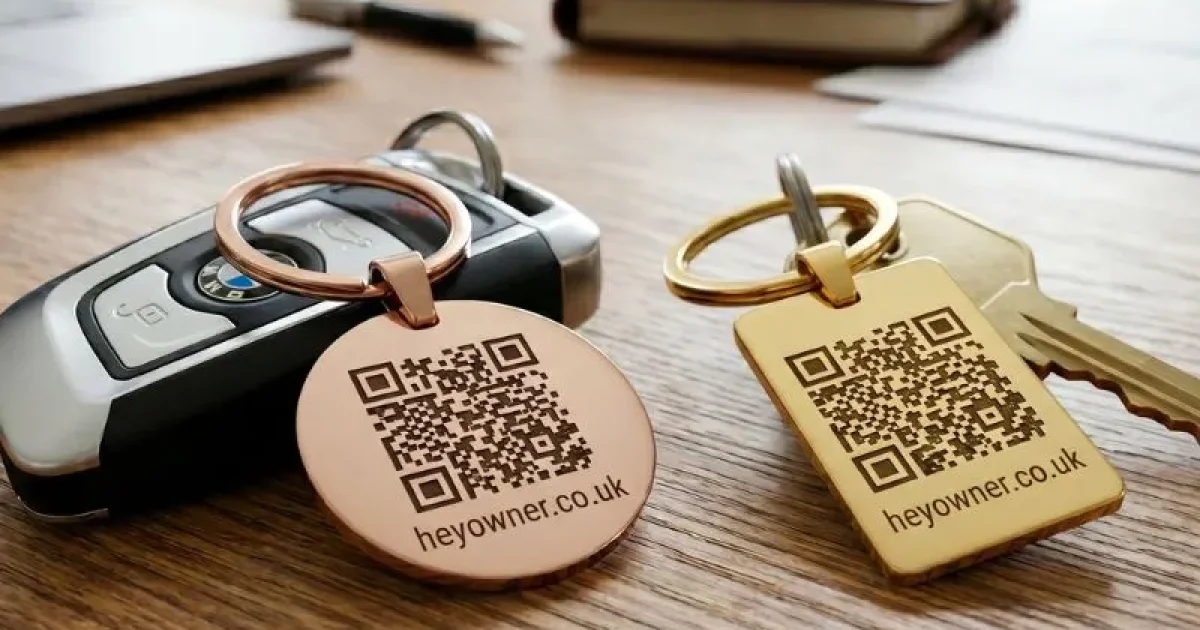
If the keys you found have a QR-coded fob or tag attached, you are in the best possible position. Open your phone's camera, point it at the tag, and within seconds you will be on a contact page where you can send the owner a message immediately. No phone number. No address. No guesswork. Just a direct, anonymous communication channel that the owner receives as a notification on their phone, wherever they are.
This is the scenario that a QR key fob is designed for. The owner set it up precisely so that a finder like you would have a simple, immediate way to get in touch. You do not need an account, you do not need to download anything, and the whole process — scan, message, done — takes less than a minute. The owner receives the notification and can reply to arrange a convenient handover location.
If the tag you found is a HeyOwner tag specifically, this step-by-step guide explains exactly what happens when you scan it and what to expect from the process.
Found a Wallet: Take Stock Before You Do Anything
A found wallet typically contains several different types of items, each presenting its own considerations. Before you take any action, take a moment to note what is inside — not to go through it intrusively, but to understand what you are dealing with and what options it gives you for returning it.
A typical UK wallet may contain some or all of the following: bank and credit cards, cash, a driving licence, an NHS card or medical alert card, an Oyster or travel pass, loyalty cards with the owner's name, a business card (the owner's own or someone else's), receipts, or miscellaneous items like stamps or coins. Each of these has a different role in helping you locate the owner.
What to Do With Cash in a Found Wallet
Leave it where it is. Do not remove cash from a found wallet under any circumstances — not "for safekeeping," not to "return it separately," and not because the notes seem loose. The owner will want to receive their wallet with its contents intact. If cash is missing when they receive it, you will be the last person to have handled it, and the situation becomes complicated and uncomfortable for everyone. Keep the wallet together and intact throughout the return process.
This applies even if the return takes several days. The cash belongs to the owner and should reach them in the same state as it left their hands.
Bank and Credit Cards
You cannot hand a found bank card to the bank directly — banks will not accept lost cards handed in by members of the public through branch counters. What you can do is contact the card issuer using the number on the back of the card (usually a 24-hour line) and report that you have found a card belonging to someone else. The issuer may be able to flag the account or — depending on their policies — make contact with the cardholder. They will typically advise you to cut up or destroy the card if the owner cannot be reached, to prevent fraudulent use.
If you are returning the wallet through another route (handing it to police, to a venue, or directly to the owner), there is no need to contact card issuers separately. The card should simply stay in the wallet. The risk of a stranger misusing a found bank card requires them to know the PIN, which they typically will not, and contactless fraud is limited to relatively small amounts per transaction. While fraud is not impossible, it is worth keeping the problem in proportion.
Personal ID Documents
A UK driving licence bearing the owner's address is one of the most useful items in a found wallet. It gives you both a name and an address — enough to post the wallet through the owner's letterbox, or to knock on the door if they live nearby. This is often the simplest and fastest resolution: put the wallet in a padded envelope, address it to the person named on the licence, and post it. If you want to notify them that it is on its way, a local Facebook post with a description of the wallet and the street or postcode it was posted from gives the owner a quick way to confirm it.
If the licence address is far away and posting is not practical for you, handing the wallet to the police with the address noted is a reasonable alternative.
Loyalty cards often carry the owner's surname on the front, which combined with other context — the area where you found the wallet, the style of cards inside — may be enough for a targeted local social media search. A driving licence is more useful, but a loyalty card is not nothing.
Handing In to the Police
Handing a found wallet or keys to the police remains the most universally reliable option when you have no other way to identify the owner and cannot resolve the situation yourself quickly. In England and Wales, you can hand found property in to any police station that is open to the public — though this has become harder to access in recent years as many stations have reduced public opening hours.
When you hand in property, ask for and keep the reference number the officer or staff member gives you. This allows you to follow up, and it provides documentation that you made a genuine attempt to return the item if the matter ever becomes complicated. Note your own contact details in case the police need to reach you.
In practice, police forces are not always well-resourced for managing and reuniting found property, and items handed in do not always reach their owners. This is not a reason to avoid handing in to police — it remains the right option in many cases — but it does mean that combining it with other approaches (a local social media post, for instance) is sensible.
Social Media and Local Posting
For found keys with no identification and found wallets where the owner's address is unknown, a post in a local community Facebook group is often the fastest way to reach the owner. Most town and neighbourhood groups have hundreds or thousands of members, and a straightforward found-property notice is typically well-received and frequently shared.
When posting about found keys, be specific enough to allow the owner to claim them but not so specific that anyone can falsely claim ownership. Describe the general area where you found them, note that you have a set of keys, and ask the owner to contact you privately with a description. When they message you, ask them to describe the key fob, any distinctive keys, the approximate number of keys, or any feature of the keyring — something specific enough that only the genuine owner would know. Do not post a photograph of the keys if they are house keys, since doing so could allow someone to copy the key profile.
For a found wallet, a post noting the general area and asking the owner to message you privately is appropriate. You do not need to describe the wallet's contents in detail publicly — doing so may actually make it harder to verify a genuine claimant, since anyone could claim the wallet if they know what is inside it. Verify by asking the claimant to describe the wallet's exterior (colour, brand, style) and then one item inside that you have not mentioned publicly.
The Security Concern: Found House Keys
A set of house keys found near a residential area without any identifying information creates a specific security consideration. In most cases, the keys are genuinely lost — dropped from a pocket, fallen from a bag — and the risk of someone misusing them is low, since they would need to know which house the keys open, which is not obvious from the keys themselves.
However, if the keys were found along with other items — a wallet containing an address, a letter, or any document linking the keys to a specific property — the combination is more significant, since it gives a potential opportunist both the key and the address. In this case, handing the complete set of items to the police, rather than attempting to return it yourself, is the safer approach. The police can contact the owner through official channels and advise them to consider changing their locks as a precaution.
If you find keys that are accompanied by a vehicle remote or fob, the combination of a car key and a nearby parked car is also worth noting. If the car's hazard lights respond to the fob, you have identified the vehicle — which may carry the owner's details in the glove box, or may be near enough to the address that knocking nearby makes sense.
Returning Items Without Sharing Your Own Address
One reason people hesitate to pursue returning found property is a reasonable reluctance to share their own contact details — their phone number or home address — with an unknown person. This concern is legitimate. Giving your address to a stranger in order to arrange a wallet handover is not something everyone is comfortable with.
Practical alternatives that avoid sharing personal details include:
- Posting the wallet directly (using the owner's address from their driving licence) — you receive nothing in return, but the property is returned safely
- Handing in to a police station, post office, or venue lost property — you are out of the chain after that point
- Arranging a handover at a public location — a town centre coffee shop, a supermarket entrance, a vet's car park — rather than your home address
- Using a local community Facebook group where messaging is done through the platform, without sharing your phone number or address directly
You should never feel obliged to give a stranger your home address to return found property. A public handover point is entirely reasonable and is the approach most conscientious finders use.
How a QR Key Fob Changes Everything
Almost every complexity in this guide dissolves when the lost keys have a QR tag attached. The finder scans it with their phone's camera, reaches a contact page, sends a brief message, and the owner receives an immediate notification. There is no need to search for an address, post on social media, hand in to police, or involve any third party. The owner replies, a handover point is agreed, and the keys are returned — often within the hour.
Found a Phone?
A found smartphone is one of the most common lost-property situations in everyday UK life — left on café tables, dropped between bus seats, forgotten at a gym counter. The approach is slightly different from keys or wallets, because a phone cannot be unlocked by a stranger to find contact details.
What you can do regardless of whether the phone is locked:
- Check the lock screen for an emergency contact. Both iPhone and Android allow users to set a medical ID or emergency contact visible without unlocking. On iPhone, tap "Emergency" on the lock screen; on Android it may show as "ICE" (In Case of Emergency). Many users have not configured this, but it is worth checking.
- Check the case for a QR tag or visible ID. Some phone cases have a QR tag on the back, a card slot containing a loyalty card or driving licence, or a name and number written on a label inside the case.
- Do not power the phone down. Powering off a phone prevents the owner from locating it via Find My or Find My Device. Leave it powered on unless the battery is critically low.
- Hand it in to the appropriate venue or lost property. A phone found on public transport should go to the operator's lost property. Found on a street, a police station is the right destination. Found in a venue, hand it to staff immediately rather than taking it away with the intention of dealing with it later.
Do not attempt to charge, reset, or access a found phone beyond the emergency contact check. A phone that is handed in promptly to staff or police has the highest chance of reaching its owner through the owner's own Find My or Find My Device system, which will show the last known location to the owner even if the phone is subsequently powered down.
Found Items at Events and Festivals
Music festivals, sporting events, outdoor markets, and community fairs generate significant volumes of lost property, particularly at the end of the event when crowds are departing quickly and items are left at stalls, under seating, or near temporary fencing. The correct approach at any organised event is straightforward: hand found property to the event's lost property point. Most sizeable events have one; ask any member of staff or steward if you cannot find it.
Taking found property away from an event venue — even with good intentions — significantly reduces the chance of the owner finding it, because their first action will be to return to the event's lost property point, not to approach random attendees. If you have already left the venue with a found item, contact the event organiser through their social media or website and arrange to post the item to them, or return it in person if the event continues over multiple days.
After an event ends, lost property offices are typically open for a defined period. Contact the organiser to find out how long unclaimed items are held and what happens to them after that point. Charity donation or disposal are the common outcomes for unclaimed items after the holding period.
Medical Alert Cards and Important Documents
A found wallet may contain items that go beyond ordinary inconvenience if they are not returned. Medical alert cards — carried by people with epilepsy, severe allergies, diabetes, heart conditions, and other conditions — are intended to inform emergency responders of the holder's condition if they are found unconscious or unable to communicate. These cards matter, and their absence can create a gap in the holder's safety documentation.
If you find a wallet containing a medical alert card and cannot quickly locate the owner through other means, note the condition listed on the card and include this information in any lost property report you make to police. In the event that the owner is found injured or unwell, this information may be passed on to emergency services through police records.
Blue Badge holders may carry their badge in a wallet or bag. A lost Blue Badge creates practical difficulty — the holder may be unable to park legally in their usual way until a replacement is issued, which involves a fee and processing time. A found Blue Badge can be handed in to any local council office or police station, which can trace it to the registered holder through council records.
The Finder's Dilemma: When Time Is Short
Real life does not always allow the thorough response that found property deserves. If you find keys on a train that is about to reach your stop, or a wallet on a pavement when you are already late, the pressure to act immediately can produce decisions that work against the owner — leaving the item somewhere visible but unsecured, handing it to the nearest stranger, or taking it with you and never quite getting around to returning it.
A practical rule of thumb: if the item has a QR tag, scan it immediately. The message can be sent in fifteen seconds and does not require you to stop for long. If it does not have a QR tag and you cannot stop, put the item in the most visible, safe location available — on top of a postbox, with a nearby shopkeeper, at the counter of the café where it was found — and tell one other person what you have done. That thirty-second act substantially improves the item's chance of reaching its owner.
The most common failure mode in found-property returns is good intentions that are not acted on immediately. A wallet taken home "to deal with later" is a wallet that ends up in a drawer for six months. A key left on a wall is a key that gets moved, rained on, and eventually discarded. Act at the moment of finding, even imperfectly, rather than planning a better response that never happens.
This is exactly what the experience of losing keys in the UK makes so vivid: the hours spent retracing steps, the cost of an emergency locksmith, the anxiety of not knowing whether your keys have been found or are simply lost. A QR fob on the keyring converts a potentially expensive and stressful situation into a quick exchange of messages.
From the finder's perspective, the experience is equally frictionless. There is no guesswork about how to reach the owner, no uncomfortable decision about what to do with a stranger's personal documents, no need to hand anything in to a police station. You scan, you send a message, and you hand over the keys at a time and place that suits both of you. The whole process is designed to be low-effort for the person who found the item — which matters, because a finder who faces friction is more likely to give up and leave the keys with a venue or hand them to police, adding days of delay to a return that could otherwise take minutes.
If you want to make your own keys — or a bag, wallet, or any item that regularly leaves the house — easier to return when lost, HeyOwner's QR key fobs and tags give any finder an immediate, no-friction way to reach you. No personal information is ever exposed to the finder. Your contact details update remotely whenever you change your number. And the next time your keys end up in a stranger's hands, they come back to you in minutes rather than days — or not at all.