11 Nov 2026
Finding a lost dog trotting towards traffic, or a frightened cat crouching in the rain with no idea where it is, puts most people in the same position: you want to help, you are not certain what to do, and the animal cannot tell you where it lives. Every year in the UK, hundreds of thousands of pets go missing — gates left open in a moment of distraction, cats that wander further than usual and lose their bearings, dogs that bolt at a loud noise and keep running. If you have found a lost pet, the good news is that the UK has well-established systems for reuniting animals with their owners. The less good news is that most people who find a stray have no idea those systems exist. This guide covers every step, from the moment you spot the animal to the moment its owner gets the call.
Step One: Approach Calmly and Assess the Situation
Before anything else, your safety and the animal's immediate welfare are the priority. A frightened or injured animal may bite or scratch even when it would never normally do so — this is survival instinct, not aggression. Approach slowly. With a dog, crouch down to appear less threatening, avoid direct eye contact (which dogs read as confrontational), and allow the animal to come to you rather than reaching towards it. Speak in a quiet, even voice. Avoid sudden movements.
If the dog is running loose near a road, your most urgent task is preventing a traffic accident. A dog that is chased will almost always run faster and further, often directly into danger. Instead, move away from the dog while calling gently, crouch down, and offer food if you have anything suitable. Some confused and frightened dogs will follow a calm human who appears to be walking away from them — their instinct to follow may override their instinct to flee. If you can position yourself safely between the dog and moving traffic using your body as a barrier, do so. Do not take risks with fast-moving vehicles.
Cats require a different approach entirely. A frightened cat that is cornered will lash out. If the cat is in immediate danger — on a busy road, trapped, or visibly injured — prioritise containing it even if that means wrapping it carefully in a jacket to protect both of you. Otherwise, give it space and time. A lost cat is far more likely to approach a person who crouches quietly and waits than one who advances or reaches out.
Other domestic animals found in unexpected places — a rabbit on a pavement, a tortoise in a front garden, a small dog too frightened to move — all respond to the same principle: slow, calm, and non-threatening. The animal has had a frightening experience. Your role in the first few minutes is to stabilise the situation, not to resolve everything at once.
Check for Identification on the Collar
Once you have the animal safely contained or under control, check immediately for any form of identification. For dogs, wearing ID is not merely good practice — it is a legal requirement. The Control of Dogs Order 1992 requires that any dog in a public place in England, Scotland, Wales, and Northern Ireland must wear a collar bearing the owner's name and address, including postcode. If the dog has a tag with a phone number on it, call it. If the call goes to voicemail, leave a message with your own number, your first name, a description of the dog, and the area where you found it. Try again an hour later — owners who have realised their dog is missing typically have their phone in their hand and may simply be out of signal range.
Be prepared for the contact details on an engraved tag to be out of date. Many owners do not replace tags when they move house or change their phone number, particularly if the pet is otherwise healthy and the tag looks fine. A tag engraved three years ago may have entirely wrong details today. If the address is in your immediate area, it is worth visiting or posting a note through the letterbox explaining that you have found the dog and giving your contact number.
QR-coded pet tags: the fastest route to the owner
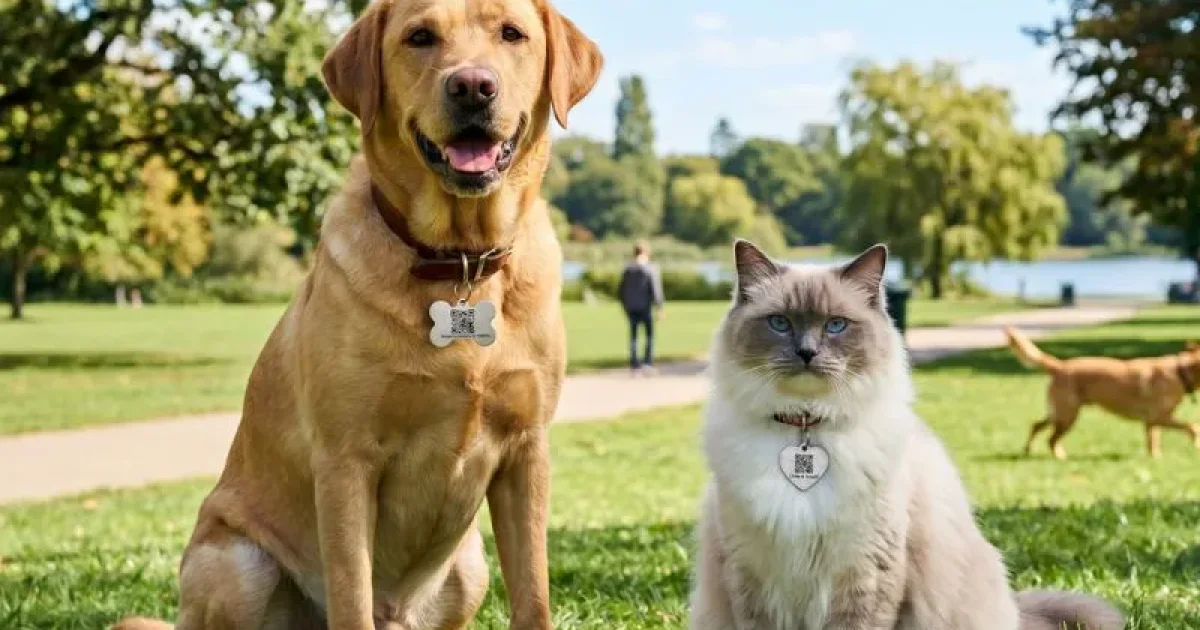
An increasing number of UK pet owners now use QR-coded tags alongside or instead of traditional engraved tags. These are typically small, round or rectangular tags with a scannable code on one side. If you see one, open your phone's camera app and point it at the code — you do not need a separate app on any modern iOS or Android device. The camera detects the code automatically and offers you a link to follow.
When you scan a QR pet tag, you are taken to a secure web page where you can send the owner a message directly, without either party revealing personal contact details. This anonymity is built in deliberately: it protects the owner's privacy while giving you, as the finder, a working channel of communication that operates immediately, at any time of day or night. Type a brief, clear message — where you found the animal, what it looks like, whether it seems healthy, and your first name. The owner receives an instant notification and can reply to arrange collection.
This process requires no account or app on your part. If the pet has a HeyOwner QR tag and you want a step-by-step explanation of exactly what happens when you scan it, this guide explains the process from the finder's perspective.
Take the Animal to a Vet for a Microchip Check
Microchipping has been a legal requirement for dogs in England, Scotland, and Wales since 2016, and for cats in England since June 2024. If the animal you have found has no visible ID — or has a collar but no readable tag — there may still be a microchip implanted beneath the skin, typically between the shoulder blades.
Any veterinary practice in the UK will scan a found animal for a microchip free of charge. No appointment is required — walk in and explain that you have found a stray. Scanning takes about thirty seconds and is painless for the animal. If a chip is detected, the vet reads the number and checks it against one or more of the major UK microchip databases: Petlog, MicroChipCentral, Anibase, and Animal Tracker among others. Most practices now use tools that query several databases simultaneously.
If the registration details are current, the vet may be able to contact the owner on your behalf, or can provide you with a name and phone number. Either way, a working microchip with up-to-date details dramatically shortens the search process.
The frustrating reality is that a significant proportion of UK pets have microchips with outdated registration details. Owners move house, change phone numbers, and forget to update the database. In these cases, the chip still confirms that the animal has an owner and is not feral — and the name on the registration may still be useful for social media searching — but it will not give you a direct path to make contact. This is precisely why visible, up-to-date ID matters so much, and why a QR tag — which can be updated remotely without replacing the physical tag — offers advantages that neither a microchip nor an engraved tag can fully match.
Report a Found Dog to Your Local Council
If the animal you have found is a dog, you have a legal obligation to report it to your local authority. The Environmental Protection Act 1990 places a duty on local councils to deal with stray dogs and to receive reports of them from members of the public. In practice, this means calling your council's dog warden service — the number is usually on the council website under "stray dogs" or "dog warden".
The dog warden will log where and when you found the dog, a description of the animal, and your contact information. This step matters because many distraught owners call the council as one of their first actions when they realise their dog is missing. If an owner reports a lost dog matching the one you have found, the warden can match the records and contact you.
You are not required to hand the dog over to the warden. You can keep the animal with you while the warden logs the details and a search is made for the owner. Many people prefer this arrangement, since council kennels are stressful environments for animals, particularly those that are already confused and frightened. However, if you cannot house the dog securely — no enclosed outdoor space, other animals that cannot be separated, or signs of aggression — the warden will arrange to collect and kennel it.
For cats, there is no equivalent stray legislation. Councils have no statutory duty to deal with stray cats in England, Wales, or Scotland. The microchip check above still applies, and it is worth calling a local animal welfare organisation such as Cats Protection or the RSPCA if the cat appears to have been missing for some time or is in poor condition.
Notify Lost-Pet Databases and Local Networks
The council and the vet are the official channels. In practice, the fastest route to reunification is often a well-placed social media post. Within minutes of going live, a found-pet post in the right local Facebook group can be seen by hundreds of people who live within a mile of where you found the animal — including the owner, their friends, and their neighbours.
Key places to report a found pet in the UK:
- Doglost.co.uk — the UK's largest dedicated lost-and-found dog database. Post a found report with a clear photograph and area. Owners search it actively and new entries are checked daily.
- PetAlert UK — covers both dogs and cats, with region-based alerts that notify local pet owners by email or text.
- Nextdoor — neighbourhood-level social network. A found-pet post here reaches only people geographically close to you, which is often exactly the audience you need.
- Local Facebook community groups — search your town name plus "lost and found pets" or "community notice board". These are typically the highest-traffic local channel and increasingly the primary way UK pets are reunited with their owners.
- Nearby vet practices — call two or three practices in the area and describe the animal. Owners frequently ring local vets when their pet first goes missing.
When posting publicly, include a clear photograph (full-body and close-up face, in natural light), the breed or best guess, sex, approximate age, coat colour and any distinctive markings, collar description, and the general area where you found the animal. Describe the temperament you have observed — is the dog friendly, nervous, submissive, lively? Specific detail helps the right owner identify their pet among dozens of similar posts.
One caution: if the animal appears very frightened and there is a risk it might bolt if a crowd converges, be careful about publishing the exact street publicly. Instead, offer the precise location only to people who message you privately. A dozen well-meaning strangers descending on a specific corner can spook a nervous dog into running further away — exactly the outcome everyone wants to avoid.
Photograph and Describe the Animal Accurately
A good photograph is worth far more than any written description. Take several shots — a full-body image in natural light, a close-up of the face, and a photograph of the collar and any tags, even if those tags appear unreadable. The colour and style of a collar is itself useful information: it may help an owner confirm at a glance that the dog in your photo is theirs before they even look at the breed or markings.
When writing a description, be as specific as possible. Generic descriptions — "brown medium-sized dog" — are nearly useless when a city produces dozens of found-dog reports per week. Useful descriptions include:
- Breed or best guess — if unknown, describe size, build, ear type (floppy or erect), tail carriage, and coat length
- Sex, if observable
- Approximate age — puppy, young adult, adult, senior
- Coat colour in detail, including secondary colours and any specific markings such as white chest, tan points, brindle patterning, or unusual facial colouring
- Any distinguishing features: a scar, a docked tail, one eye, unusual proportions
- Collar details: colour, material, buckle style, any remaining tags even if unreadable
- Body condition: does the dog appear well-nourished and recently groomed, or does it seem thin, matted, or neglected?
- Observed temperament: relaxed, submissive, nervous, reactive, very friendly
For cats, note coat length and pattern — tabby, tortoiseshell, calico, solid black, bicolour — and whether the cat appears to be an indoor or outdoor cat based on how confident it is outdoors. A cat that is clearly disoriented and stressed in an open environment may never have been outside before, which significantly affects how you handle it and how you describe it in a found notice.
Dealing With an Injured Animal
If the animal appears injured, the urgency increases considerably. A dog struck by a vehicle may have internal injuries that are not immediately visible — it may be standing and walking but still be seriously hurt. Warning signs include laboured breathing, pale or white gums, disorientation, inability to bear weight on one or more legs, a distended abdomen, excessive bleeding, or loss of consciousness.
Do not attempt to splint or bandage injuries yourself unless you have specific veterinary first-aid training. Moving an injured animal incorrectly can worsen spinal or limb injuries. If the animal is on a road, getting it to safety is the immediate priority — use a coat or blanket as a makeshift stretcher if available, supporting the whole body rather than picking it up by the middle. Call the nearest vet practice as you move and explain that you are bringing in a road traffic casualty — most practices will be ready for your arrival.
The RSPCA (0300 1234 999) and, in Scotland, the SSPCA (03000 999 999) can attend injured stray animals, though response times vary and in a genuine emergency transporting the animal directly to a vet is usually faster. Police can also be called for large animals or situations where a road hazard is involved — they have duties relating to road traffic casualties involving animals.
Keeping the Animal Safe While You Search
If you are housing a found dog temporarily, security is your first concern. A dog that is confused and searching for its home will attempt to escape in ways your own settled dog would never try. Check every fence panel, gate, and gap. Keep the dog on a lead within the garden if your enclosure is not fully escape-proof. Inside the house, keep street-facing doors closed.
Do not introduce a found dog to your resident pets immediately. You do not know the dog's history with other animals, and the stress of an unfamiliar environment can make an otherwise sociable dog reactive. Keep them separated, with visual barriers between them, until the situation stabilises. This is particularly important if you have resident cats — an unknown dog in the house is extremely stressful for a cat, and a dog that has not been cat-tested may give chase instinctively.
Offer fresh water straight away. For food, a small amount of bland food is appropriate — plain boiled chicken and rice if you have it, or a modest portion of dry biscuits. If the dog has been missing for an extended period, a large meal can cause digestive upset. Feed little and often rather than one large feed while you make enquiries.
A found cat that is very frightened will benefit from being confined to one quiet room with food, water, a litter tray, and a hiding place — a box or the space under a bed. Give it several hours before attempting to interact. In most cases, a genuinely lost domestic cat will calm down considerably once it feels physically safe, and by the following morning it will often be responsive and approachable.
Managing the overnight situation
If the owner has not been located by evening, continue your search online before going to sleep. Check Doglost and the relevant Facebook groups for any newly posted lost-dog reports matching the animal you have found. Many owners only realise their pet is missing in the late afternoon or early evening, so new reports may have appeared hours after your original post.
Post an update confirming the animal is still with you and safe. A brief comment — "Update: still here, still searching for the owner" — keeps the post active in people's feeds and reassures anyone who has shared or bookmarked it. A new photograph of the animal looking calm and settled will often generate more shares than a text update alone.
What Not to Do
A few common mistakes are worth naming directly.
- Do not keep the animal without reporting it. However appealing the dog is, failing to report a found animal to the council and make genuine efforts to locate the owner is not acceptable, legally or ethically. Report first; keep if unclaimed.
- Do not post the exact location publicly if the animal is still loose. A crowd converging on a specific address can spook a frightened dog into bolting. Share the precise location only with people who message you privately.
- Do not give large amounts of food immediately. An animal that has been without food for hours can suffer digestive problems from a large sudden meal. Small amounts and frequent fresh water is the right approach.
- Do not introduce the found animal to your own pets without a settling period. Even the most sociable resident dog may react badly to a confused, stressed newcomer.
- Do not hand the animal over without proof of ownership. A genuine owner will understand why you are asking and will have at least one piece of credible evidence ready.
Verify Ownership Before the Handover
When someone contacts you claiming to be the owner, take a moment to verify before releasing the animal. Most genuine owners will understand immediately — they have been searching frantically for hours and know that a responsible finder will want confirmation. Reasonable proof of ownership includes a photograph of the owner with the animal taken before it went missing, a vet card or vaccination record bearing the pet's name and the owner's address, a microchip registration document, or specific knowledge of a distinguishing feature that you did not mention publicly.
A genuine owner will produce at least one of these without hesitation. Arrange the handover in a simple, accessible location — outside your house, a nearby car park, or the local vet practice if there is any doubt about the identity of the person claiming the animal. The handover itself need not be lengthy. Confirm ownership, hand over the animal, exchange contact details if relevant, and let owner and pet be reunited without prolonged delay.
After the Reunion: Close the Loop
Once the pet is safely home, spend a few minutes closing the loop on every post and report you made. Update or delete your found-dog notices on Doglost, Nextdoor, and local Facebook groups. A brief "reunited — thank you everyone" message prevents people from continuing to contact you about an animal that is already home, and it keeps the databases clean for other users. Lost dogs in your area in future are better served by a clear, accurate database than by weeks-old unresolved found-dog reports cluttering the search results.
If the dog warden was involved, let them know the outcome. Councils track reunification data, and a quick call or email confirming that the stray dog reported on a given date is now back with its owner takes thirty seconds and adds useful information to the public record.
If No Owner Comes Forward
In some cases, despite genuine effort over several days, no owner appears. In England and Wales, a stray dog that has been reported to the local authority and is not claimed within seven days becomes the legal property of the person housing it. This does not create an obligation to keep the dog permanently — but it does mean that if you choose to rehome it, you may do so legally.
Options at this point include keeping the dog yourself if you are able and willing, contacting a local rescue organisation, or approaching a breed-specific rescue if the dog's breed is identifiable. Most rescues operate with waiting lists for incoming animals, but a healthy, well-tempered dog with no traceable owner can generally be placed within a few weeks.
Before concluding that no owner exists, make one final thorough sweep: post a physical notice near where you found the animal, and on the noticeboard of the nearest post office, vet practice, pet shop, and newsagent. Some owners are not active on social media and rely entirely on physical neighbourhood networks. Older owners in particular may be searching the streets on foot and may have missed your online posts entirely. A laminated notice at the location where you found the dog costs very little effort and may be the thing that bridges the gap.
Make Your Own Pets Easier to Return
Helping a stranger find their lost pet is a practical reminder that the UK's pet identification systems have real limitations. Microchips are mandatory but their data goes stale. Engraved tags work only when the information is current and the tag remains legible. In either case, the finder — someone like you — still needs to know how to navigate databases and reporting systems that most people have never encountered before.
A QR-coded pet tag changes this dynamic entirely. The finder does not need to know about microchip lookup services, dog wardens, or lost-pet websites. They see a code, they scan it with their phone's camera, they send a message, and you receive a notification. That is the whole process. Your contact details can be updated remotely when you move or change number — the tag keeps working. And you can see when and where it has been scanned, which can itself be a useful clue if your pet goes missing.
Found an Exotic or Unusual Animal?
Cats and dogs account for the vast majority of found-pet cases in the UK, but not all lost animals fit neatly into those categories. Tortoises and terrapins that have escaped from gardens are found regularly in residential areas during warm weather — a tortoise moving at its own pace can cover surprising distances in a day. Parrots and other exotic birds occasionally escape through an open window or aviary door, and are found perched in unexpected places, often too confused or frightened to fly back. Ferrets are active escape artists that find their way out of enclosures regularly and may travel considerable distances before being found.
For exotic animals, the appropriate first step is containment without injury to yourself or the animal. Most exotic reptiles are harmless to handle; some are not. If you are unsure whether an animal is dangerous, do not attempt to handle it. Call the RSPCA (0300 1234 999) or the non-emergency police line (101) for guidance. Local exotic pet shops, specialist vets, and dedicated Facebook groups for specific species — parrots, reptiles, tortoises — are often the fastest route to identifying an unusual animal and finding its owner. A lost parrot in a residential area almost certainly has a local owner who is already searching, and a found-parrot post in the right online community can produce a response within hours.
Microchipping and QR tagging are less common for exotic animals, but a photograph posted in the appropriate online community is usually sufficient to trigger rapid contact from the owner. Exotic pet owners tend to be closely networked, and specific species communities — whether for African grey parrots, Hermann's tortoises, or ball pythons — are active and well-connected. One post in the right group can solve the problem faster than any official channel.
Physical Searches: Where Lost Pets Actually Hide
Social media appeals and database notifications are essential, but they work in parallel with physical searches — not instead of them. Many lost pets are found within a surprisingly short radius of where they were last seen, hiding in places that are easy to overlook during an anxious search.
Common hiding spots worth checking systematically:
- Under vehicles parked on the street — a frightened animal will seek a low, enclosed space, and a wheel arch is exactly that
- Inside garden sheds and outbuildings left with open doors — a panicking animal may have run inside and been shut in by a subsequent visitor
- Dense hedge bases and undergrowth — cats in particular will press themselves deep into vegetation and stay still for hours
- In neighbours' gardens — knock on doors within two or three houses of where the animal was last seen and ask permission to check gardens
- Under decking or raised garden features — small dogs and cats commonly hide in the dark space beneath raised structures
When searching, move quietly rather than calling repeatedly and loudly. A very frightened animal may suppress its own vocalisation and press further into hiding if it hears a lot of noise and activity. A slow, systematic physical search of the immediate area is often more productive than a noisy appeal at a distance.
As this earlier article discusses in more detail, a QR tag also resolves the privacy problem that engraved tags create: your phone number and home address are never visible to the stranger who finds your pet. They see only a contact form. You receive a private message and decide how to respond.
If you would like to make your own pets quicker and easier to return, browse HeyOwner's QR pet tags. Every tag links to a private contact page that any finder can reach with a standard smartphone camera — no app, no account, and no friction. The process this entire guide describes shrinks to a single scan and a short message.