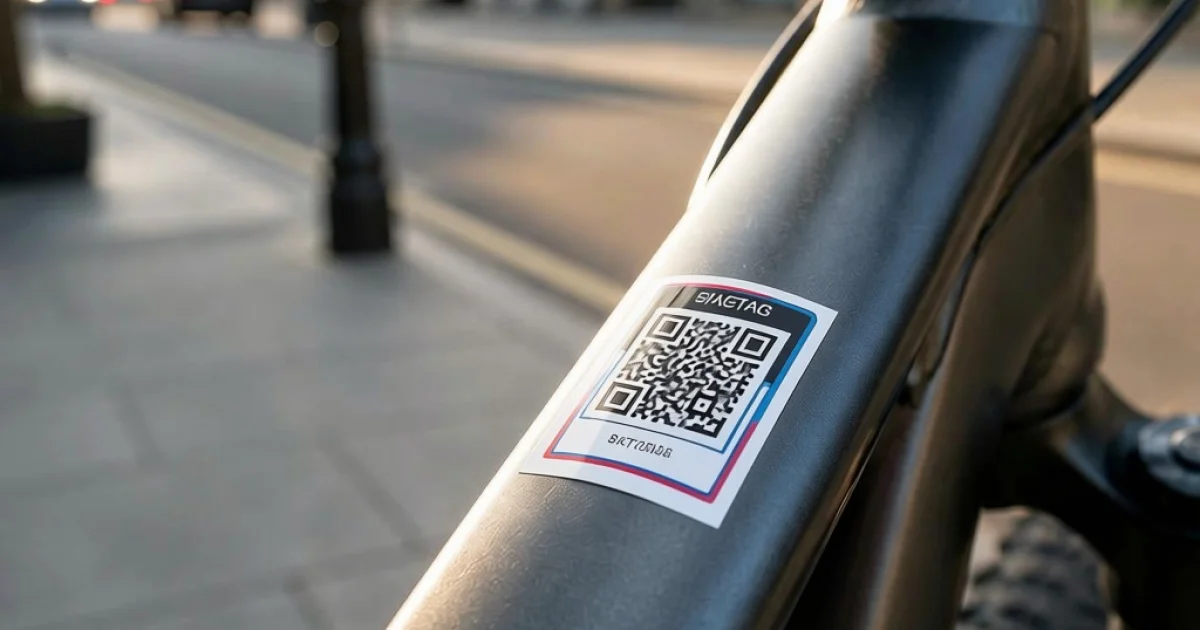
A bike with no identification is almost impossible to return. In the UK a bicycle is stolen roughly every minute, and while police forces recover thousands of them, most sit in storage and are eventually auctioned or scrapped for one simple reason: nobody can prove who they belong to. The same problem plays out on a smaller scale every day — a bike left at a station, an e-scooter grabbed by mistake from a busy rack, a child's bike abandoned in a park. Tagging your bike solves the identification half of that problem. This guide explains how to tag a bike or e-scooter properly in the UK, the difference between the various methods, and how a QR tag lets a finder reach you without ever seeing your personal details.
Why Tagging Your Bike Matters More Than You Think
Most people think about bike security as a single question — which lock to buy. A good lock is essential, but it only addresses theft in progress. It does nothing for the far more common situations where your bike ends up separated from you but not actually stolen: left behind after a train journey, moved by a warden or building manager, or found dumped in a hedge by someone who wants to return it. In all of these cases, a lock is irrelevant. What matters is whether the person who has your bike can work out that it is yours and how to reach you.
Tagging is also what turns a recovered bike back into your bike. When police recover stolen cycles, the barrier to reuniting them with owners is almost never finding the bike — it is proving ownership and locating the person. A bike that carries a clear, scannable identifier and a recorded frame number is in a completely different category from an anonymous frame with no paperwork.
How to Tag a Bike: The Four Layers of Bike ID
There is no single "bike tag" that does everything. The strongest approach combines up to four layers, each covering a different scenario.
- Record your frame number. Every bike has a unique frame number, usually stamped underneath the bottom bracket where the pedals attach. Photograph it and write it down. This is the single most important piece of ownership evidence you have, and the police will ask for it first.
- Register the bike. Free national schemes such as BikeRegister let you log your frame number and photos against your name, so a recovered bike can be traced. Many police forces run marking events using these databases.
- Add a visible QR tag. A frame number is invisible to the public and a database entry only helps once the police are involved. A visible QR tag is the layer that lets an ordinary member of the public — a fellow commuter, a warden, a good Samaritan — contact you directly and immediately.
- Keep a digital logbook. Storing your frame number, make, model and photos in one place means you can produce proof of ownership in seconds if you ever need to.
The first two layers help the authorities. The QR tag is the one that works in the real world, in the moment, without anyone needing to file a report first.
What Is a Bike QR Tag and How Does It Work?
A bike QR tag is a small, weatherproof sticker or fob carrying a unique QR code, fixed to your frame or handlebars. The code links to a secure online profile that you control. When someone finds your bike — abandoned, moved, or simply looking like it needs attention — they point their phone camera at the code, and it opens a page where they can send you a message.
Crucially, they never see who you are. The message reaches you through a private relay, so a finder can tell you exactly where your bike is or what has happened to it while your name, phone number and home address stay completely hidden. You get an instant notification and decide how to respond. No app to download, no account for the finder to create — any modern phone reads the code straight from the camera.
You can read more about how this everyday recovery works for bikes and scooters on the bicycles and scooters use-case page.
QR Tag vs a Sticker With Your Phone Number
Some cyclists write a phone number on their frame in marker or on a luggage-style label. It works, but it broadcasts your personal number to everyone who passes your bike — including people who have no reason to have it. Once it is on there, you cannot control who photographs it or when you start receiving unwanted contact.
A QR tag gives you the same "please contact the owner" function without the exposure. The finder gets a way to reach you; you get to stay anonymous until you choose to reply. If your priorities are recovery and privacy at the same time, the QR approach wins clearly. This is also the fundamental difference between QR tags and location trackers like AirTags, which we cover in detail in QR Tags vs AirTags.
Does a Bike QR Tag Double as a Cyclist ID?
It can, and for many riders this is the most valuable part. A tag on your frame or helmet can carry not just a lost-and-found relay but an emergency profile — a cyclist ID that shows a responder who to call and what they need to know if you come off your bike and cannot speak for yourself. Cyclists spend a lot of time alone, moving fast, sometimes off the main road, which is exactly when a clear emergency ID matters most. If that appeals, the Emergency ICE tag combines everyday recovery with a medical and ICE-contact profile on the same tag.
Where to Put the Tag on Your Bike or Scooter
Placement matters, because a tag only helps if a finder actually spots it. The best positions are visible without being in the way of moving parts:
- The top tube or head tube — the most visible flat surface on most frames, and the first place a curious finder looks.
- The handlebar stem — eye level and hard to miss, ideal on both bikes and e-scooters.
- The seat post or seat tube — a good second position, and a discreet spot for a backup tag.
- The helmet — the natural home for an emergency ID, since it stays with you rather than the bike.
For e-scooters, the stem or deck works well. Adding a second, less obvious tag as a backup is worth doing on anything high value — if one is peeled off, the other still works.
Will It Survive UK Weather — and Does It Work for E-Scooters and Kids' Bikes?
A bike tag lives outdoors all year, so the material has to cope with rain, road grime, UV and the occasional jet wash. Quality weatherproof vinyl and laser-engraved tags are built for exactly this and stay scannable through British winters. There are no batteries and nothing to charge, so it keeps working indefinitely.
The same tag works for e-scooters, e-bikes, cargo bikes and children's bikes. For kids' bikes it is particularly useful: if a child leaves a bike at the park or outside a friend's house, a finder can reach the parents immediately without any personal details being on display.
How to Tag Your Bike, Step by Step
- Find and photograph your frame number. Look under the bottom bracket. Save the photo and note the number somewhere safe.
- Register it on a free national scheme such as BikeRegister so a recovered bike can be traced back to you.
- Order a QR tag and fix it to a visible spot on the frame or stem — HeyOwner tags start at £5.99 with UK delivery included.
- Scan to activate and add your bike's details — make, model and frame number — to your secure profile.
- Add a backup and, if you ride alone, a cyclist ID so a responder can reach your emergency contact if you ever need help.
Do those five things and your bike moves from anonymous-and-unrecoverable to identifiable, traceable, and reachable — without a single personal detail on public display.