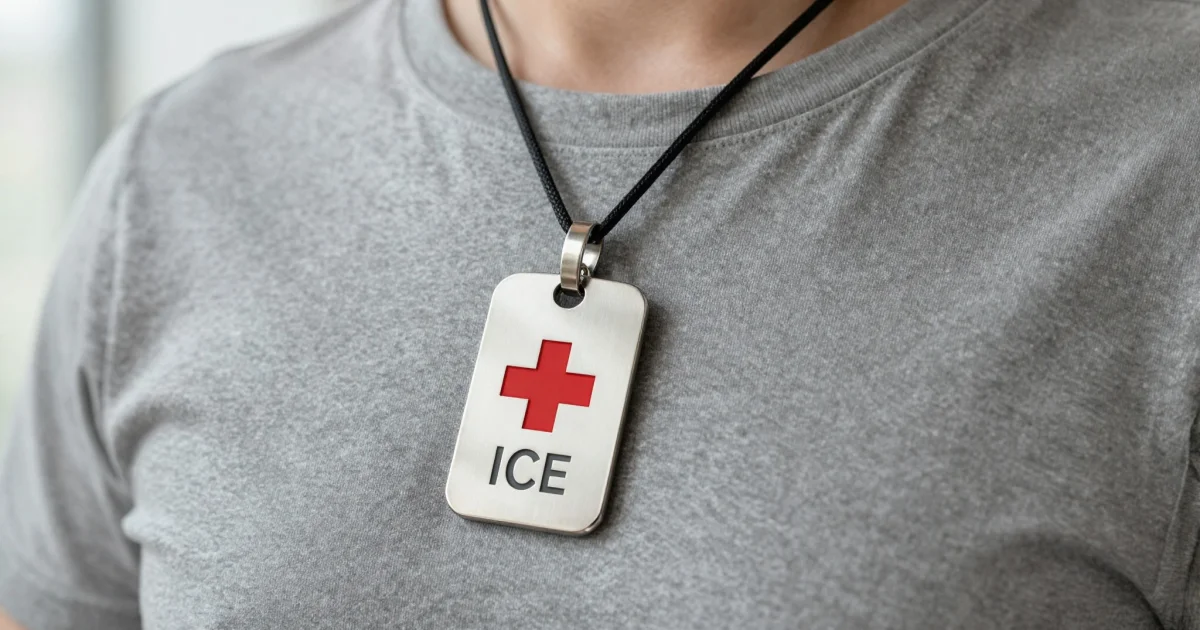
An ICE medical ID exists for the moments you cannot speak for yourself. If you are unconscious after a fall, a road accident or a sudden medical episode, the people trying to help you — a passer-by, then a paramedic — have almost nothing to go on. An emergency ID closes that gap in the first few minutes, when the right information matters most. This UK guide explains what ICE means, exactly what to put on an emergency tag, and how a QR-based ICE tag shows responders what they need while keeping your personal and medical details private until they are actually needed.
What Does ICE Mean?
ICE stands for In Case of Emergency. The idea started as a simple convention — saving a contact in your phone as "ICE" so ambulance crews knew who to call — and has grown into a broader principle: keeping key emergency information somewhere a responder can find it quickly. An ICE medical ID is any item that carries that information on you, whether it is an engraved bracelet, a card in your wallet, or a scannable tag.
UK ambulance crews are trained to look for emergency identification, and a clear ICE ID can save them critical time establishing who you are, who to contact, and whether you have a condition that changes how they treat you.
What to Put on an Emergency Medical ID
A good emergency ID does not need much — just the details that change what happens in the first few minutes. Include:
- ICE contact(s) — one or more people a responder should call. This is the single most important field.
- Blood group — if you know it.
- Key conditions — anything that affects emergency treatment, such as epilepsy, diabetes, a heart condition or asthma.
- Serious allergies — especially medication allergies and anything that could cause anaphylaxis.
- Regular medication — particularly blood thinners, insulin or anything that interacts dangerously with emergency drugs.
- NHS number — optional, but it helps hospital staff pull up your records.
Keep it concise. An emergency ID is not your full medical history — it is the handful of facts a stranger needs to act correctly and reach the people who know you.
Traditional ICE Options and Their Limits
The two most common approaches each have a real weakness. An engraved medical bracelet is always visible and needs no technology, which is a genuine strength — but the surface is tiny, so it can only carry a few words, it cannot be updated when your medication or contacts change, and it tells a responder nothing beyond what is scratched into the metal. An ICE contact saved in your phone can hold more, but a locked phone, a flat battery or a cracked screen makes it useless at exactly the wrong moment, and it cannot alert anyone on your behalf.
Both share a deeper limitation: they are static. They sit there and wait to be read, and neither can tell your emergency contact that something has happened.
What Is a QR ICE Tag?
A QR ICE tag is a small, weatherproof tag — for a helmet, bike frame, bag, wristband or keyring — carrying a QR code that links to your emergency profile. A responder scans it with any phone camera, no app required, and sees only the fields you have chosen to show. Because the information lives on a web page rather than on the metal itself, it can hold as much or as little as you like, and you can update it any time without replacing the tag.
The tag can also do something an engraving never could: when it is scanned, it can send your ICE contact an instant message with an approximate location, so the people who matter know to check on you. You can see how this works in practice on the Emergency ICE use-case page.
Is It Safe to Put Medical Data on a QR Tag?
This is the right question to ask, and the answer comes down to control. With a well-designed ICE tag, nothing is shown by default — every field starts switched off, and you decide one by one whether your ICE contact, blood group, conditions, allergies or medication are visible to someone who scans it. Medical details are special category data under UK GDPR, so they should be stored encrypted against your profile and never printed on the physical tag. The QR code itself contains no personal information; it is simply a link to a page whose contents only you control. If you ever want to change or remove a detail, you do it from your account in seconds.
This is the key difference from an engraving, which is permanent and public the moment it is made. A QR tag lets you be reachable and informative in an emergency while staying private the rest of the time.
Who Is an ICE Tag For?
Anyone can benefit, but an emergency ID matters most for people who are active, alone, or managing a condition. Cyclists, motorcyclists, runners, hikers and horse riders spend time moving fast or off-grid, often without a companion — exactly when a clear ID counts. If you ride, an ICE profile doubles neatly as a cyclist ID on your bike or helmet. And for anyone living with epilepsy, diabetes, a heart condition or a severe allergy, an ICE tag makes sure the one fact a responder must know reaches them immediately, whether or not you are able to tell them yourself.
How to Set Up Your ICE Tag, Step by Step
- Order your tag and choose where it will live — helmet, bike frame, bag or wristband. HeyOwner tags start at £5.99 with UK delivery included.
- Scan to activate and create your emergency profile.
- Add only what matters — your ICE contact first, then blood group, conditions, allergies or medication as needed.
- Switch on the fields you want visible. Everything stays hidden until you choose to show it.
- Set your ICE contact to be alerted so they receive a message with an approximate location whenever your tag is scanned.
Set up once, and you carry a quiet layer of protection that speaks for you when you cannot — without putting your private details on display for the rest of the time.