11 Nov 2026
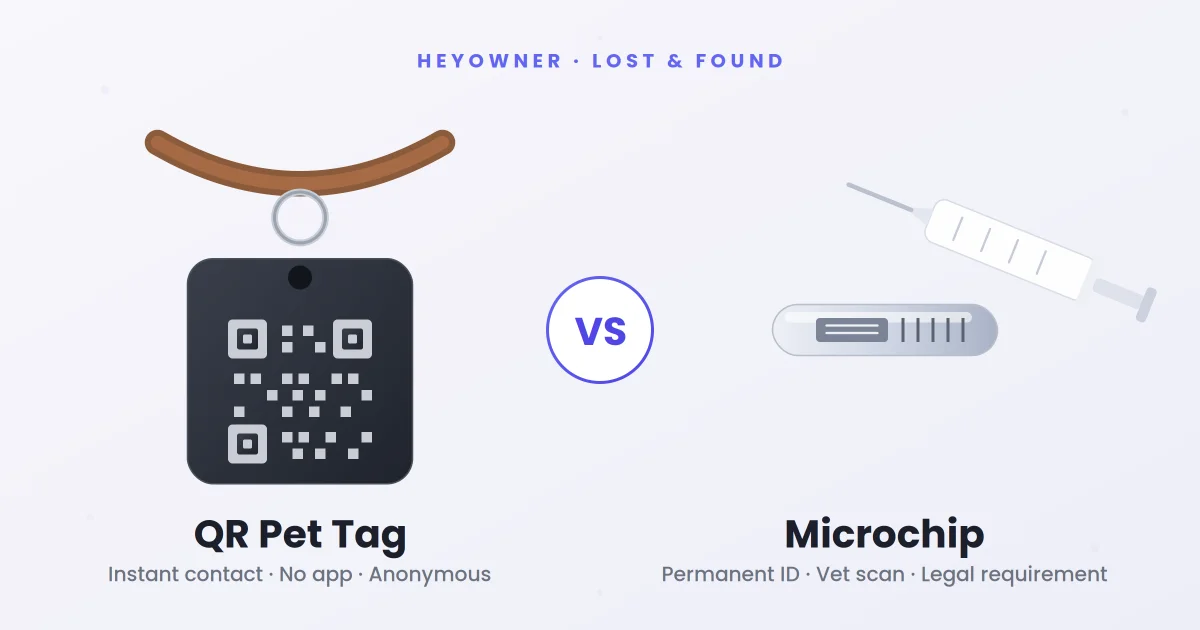
If you have ever searched online for how to protect a lost pet, you will have encountered both microchips and QR tags — sometimes presented as alternatives to each other, sometimes as completely unrelated technologies. They are neither. A microchip and a QR pet tag are complementary tools that work at different stages of the lost-pet process, for different audiences, through different mechanisms. Understanding what each one does — and, just as importantly, what each one cannot do — is essential for any UK pet owner who takes their animal's safety seriously. This guide explains both technologies honestly, including the legal requirements that make microchipping non-negotiable, and the practical gaps that a QR tag fills where a microchip simply cannot.
What a Microchip Actually Is
A pet microchip is a passive radio-frequency identification (RFID) transponder — a tiny electronic device approximately 12 millimetres long and 2 millimetres in diameter, sealed in a biocompatible glass capsule. It contains no battery and no active power source. Left alone, it does nothing. It only responds when a compatible scanner is passed over it, at which point the scanner's radio signal provides just enough energy to activate the chip, which broadcasts a unique 15-digit identification number back to the scanner.
The number itself means nothing in isolation. It is simply a reference code — a serial number — which is then looked up against a database that links the chip number to the animal's details and the owner's contact information. The chip is implanted by a veterinary professional, typically between the shoulder blades, in a procedure that takes a few seconds and is no more uncomfortable for the animal than a standard injection. Once implanted, a chip is designed to last the animal's lifetime, embedded in the surrounding tissue.
The ISO 11784 and 11785 standards govern the format and radio frequency used by chips in the UK and most of Europe — 134.2 kHz and a 15-digit code. These standards ensure that chips implanted in the UK can be read by any modern ISO-compliant scanner worldwide, which is important for international travel. Older chips using different standards do still exist in animals that were chipped before standardisation became widespread, and not all scanners read all chips — which is worth knowing if you are travelling abroad with a pet that was microchipped some years ago.
How Microchipping Works in Practice
When a stray animal arrives at a vet practice, a rescue centre, a council kennels, or an RSPCA facility, one of the first actions is to scan for a microchip. The scanner is passed slowly over the animal's body — not just between the shoulder blades, since chips can migrate slightly over time — and if a chip is present, the number appears on the scanner's screen. The operator then looks up the number using a database tool.
In the UK there are several competing microchip databases: Petlog (operated by the Kennel Club and one of the largest), MicroChipCentral, Anibase, Animal Tracker, and others. There is a central government-backed lookup tool at Check-a-Chip (check-a-chip.co.uk) that queries multiple databases simultaneously, which most professionals now use as their first port of call. If the registration details are current, the lookup returns the owner's name and contact information, and the owner can be called.
This process works smoothly when everything is in order. When it does not work — when the chip number returns outdated details, or no result at all — reunification becomes far more difficult and time-consuming.
Microchipping Is a Legal Requirement in the UK
It is important to be direct about this: microchipping is not optional for dog and cat owners in the United Kingdom. It is a legal requirement, and failure to comply carries financial penalties.
For dogs in England, Scotland, and Wales, microchipping has been compulsory since 6 April 2016. Dogs must be chipped by the age of eight weeks, and the chip must be registered to a database. In Northern Ireland, compulsory microchipping for dogs has been in place since 2012. The penalty for an unchipped dog in England and Wales is a civil penalty of up to £500. Dog wardens and authorised officers have the power to check whether a dog is chipped during routine encounters.
For cats in England, compulsory microchipping came into force on 10 June 2024. Cats must be chipped by the age of 20 weeks. The legislation applies in England; Scotland and Wales have indicated intent to introduce similar requirements, with consultations ongoing. The same financial penalty structure applies.
A QR pet tag is not, under any circumstances, a substitute for microchipping. It does not fulfil the legal obligation. A chip embedded beneath the skin is verifiable by any authorised scanner; a QR tag on a collar can be removed. These are fundamentally different types of identification, and the law requires the chip.
What a Microchip Cannot Do
Understanding the limitations of microchipping is just as important as understanding what it does, because those limitations are where a QR tag provides genuine and significant value.
A microchip is a passive device. It does not transmit any signal unprompted. It does not communicate with your phone. It does not tell you where your pet is. It does not alert you when your pet has been found. It cannot be read by a member of the public with a standard smartphone — reading a microchip requires a specialist RFID scanner that virtually no ordinary person owns. If your dog escapes and is found by a neighbour, a park-goer, or a child on their way home from school, the microchip is completely inaccessible to them.
The microchip's value is realised only at the point of professional intervention: when the animal reaches a vet, a rescue centre, or a council warden — and only when that professional has a compatible scanner and access to an up-to-date database. In urban areas during working hours, this pathway works reasonably well. In rural areas, out of hours, or when an animal is found by someone who simply wants to return it without involving official systems, the microchip offers nothing.
There is also the staleness problem. A microchip is permanent; the registration is not. When an owner moves house, changes their phone number, or acquires a pet from someone else, the database entry must be manually updated — and a significant proportion of UK pet owners have never updated their chip registration since the initial implantation. The chip exists; the data behind it is wrong. In these cases, the chip identifies an animal but cannot lead a finder to its owner.
What a QR Pet Tag Actually Is
A QR pet tag is a physical tag — usually metal, silicone, or hard-wearing plastic — attached to the animal's collar, bearing a machine-readable QR code on its surface. The code links to a web page, typically a contact or profile page managed by the tag's owner. When scanned, the page allows a finder to send a message to the owner without either party revealing their personal contact details.
Unlike a microchip, a QR tag requires no specialist equipment to read. Any modern smartphone camera — iOS or Android — can detect and decode a QR code in seconds, without downloading a separate app. This means any member of the public who finds the animal can access the contact page immediately, from their own device, at any time of day.
The tag is linked to an online account where the owner manages their contact details. If the owner moves house, changes their phone number, or wants to add or remove information, they update their account — and the tag continues to work. The physical tag never needs to be replaced. This is a direct solution to one of the most common microchip failures: stale data.
How a QR Tag Works in Practice
The experience from the finder's perspective is deliberately frictionless. A person finds a dog with a QR tag. They open their phone's camera, point it at the tag for a moment, and follow the link that appears. They land on a contact page showing the pet's name (if the owner has set this up) and a simple message form. They type a brief message — where they found the dog, what it looks like, that it is safe — and submit it. The owner receives an instant notification on their phone, wherever they are. They can reply through the same platform and arrange to collect the animal.
The entire process, from scanning to message sent, takes under a minute. Neither the owner's phone number nor their home address is exposed at any point. The finder does not need an account. The owner does not need to be near a computer. And the notification arrives immediately — not hours later when an official agency gets round to making contact.
This is the gap that a microchip leaves entirely open, and that a QR tag fills completely.
What a QR Tag Cannot Do
Honest comparison requires acknowledging the limitations of QR tags as well.
A QR tag works only when it is visible and accessible. If the tag is obscured by fur, turned to face the wrong way, or damaged, a finder may not notice it or may not be able to scan it cleanly. A microchip, embedded beneath the skin, cannot be obscured or turned the wrong way. For long-haired breeds where collar tags can be hidden in fur, this is a practical consideration.
A QR tag also depends on a finder choosing to scan it. Most people who encounter a stray animal and notice a QR code will scan it — but not everyone is aware that pet QR tags exist or what they do. As QR tags become more common among UK pet owners, finder awareness is improving, but it is not universal.
A QR tag can be lost. Collars come off, tags fall off, and an animal that escapes a garden may arrive at a stranger's door without the collar it was wearing when it left. A microchip, properly implanted, stays with the animal for life regardless of what happens to its collar or tags.
Finally, a QR tag does not fulfil the legal microchipping requirement. This cannot be overstated. A QR tag on a collar is visible identification, not the legally mandated form of identification. The chip requirement exists precisely because collar tags can be removed, lost, or transferred between animals.
What a Microchip Can Do That a QR Tag Cannot
The microchip's strengths are almost the mirror image of the QR tag's.
It is permanent and tamper-proof. Once implanted, it cannot be accidentally lost, deliberately removed without surgery, or transferred to a different animal. For proof of ownership — in a dispute between two people claiming the same dog, for example — a microchip is definitive in a way that a collar tag is not.
It is readable by professional networks. Every vet practice, rescue centre, RSPCA facility, and council warden has or can access a microchip scanner. When an animal enters the professional animal welfare system, the microchip is the universal, standardised identifier that every operator in that system is trained and equipped to use.
It works internationally, across systems, and regardless of whether the animal is wearing a collar. For travel abroad, a microchip meeting ISO standards is a requirement for entry to most countries with their animal import and pet passport rules. No QR tag — however useful domestically — replaces a microchip in this context.
Why Every Responsible Owner Needs Both
The lost-pet reunification process involves two different audiences: members of the public who find the animal, and professional animal welfare operators who process stray animals through official channels. These two groups use different tools.
A microchip is the tool for professionals. It is permanent, scanner-readable, and legally required. A vet, a warden, or a rescue centre will always check for a chip first. If the chip data is current, reunification through this channel is straightforward.
A QR tag is the tool for members of the public. It requires no specialist equipment and works immediately from any smartphone. It connects the finder directly to the owner, bypassing the professional system entirely — which, in most cases, is faster and less stressful for both owner and animal.
The ideal scenario is not a choice between these two technologies. It is both, used together, for their respective strengths. A lost dog that reaches a rescue centre can be identified by its chip and returned through the official system. The same dog, found by a well-meaning teenager in a park, can be returned in minutes through a QR tag scan. Without both, you are relying on one channel and hoping the other is not needed.
As this earlier article explains, a QR tag also resolves the privacy problem that traditional engraved tags create: your phone number and home address are never visible to the person who picks up your pet. That combination — chip for the official system, QR tag for the public — gives your pet the most complete identification coverage available.
Keeping Your Microchip Registration Current
Given that stale microchip data is one of the most common reasons a chip fails to reunite an animal with its owner, this step deserves its own section. Updating your registration takes about five minutes on the relevant database website, but a surprising number of pet owners have never done it since the chip was first registered — often because the registration was handled by a breeder, a rescue, or a previous owner, and the current owner has never verified the details under their own name.
You can check the current registration details for your pet's chip using the Check-a-Chip tool at check-a-chip.co.uk. Enter the chip number (which your vet will have on file) and the tool will tell you which database holds the registration and whether it can find an active record. If the details are wrong or out of date, contact the relevant database directly to update them — each has a web-based process for this.
Key moments to check and update your microchip registration:
- When you move house
- When you change your phone number
- When you acquire a pet from a breeder, rescue, or private seller — always verify the chip is registered in your name
- When you take on a pet from another owner — the transfer must be recorded on the database
- When you change your email address (if the database uses email for alerts)
The annual cost of maintaining a microchip registration is typically nothing — most UK databases offer lifetime registration for a one-off fee paid at the time of chipping. The effort required to check and update details is minimal. The cost of stale data, when your lost pet cannot be reunited because the phone number on the chip is three moves out of date, is potentially very high.
Privacy: Microchip, QR Tag, and Engraved Tag Compared
Pet owners sometimes worry that attaching identification to their pet creates a privacy risk — that their home address or phone number will be visible to strangers. The answer depends entirely on which type of identification you are using.
An engraved tag with your address and phone number is the maximum exposure option. Every person who reads that tag sees your personal contact details. If your dog wanders regularly, your home address is potentially readable by many people over the course of a year.
A microchip is, from a privacy perspective, very well-protected. The chip number alone reveals nothing. Only a professional with scanner access and database credentials can look up the owner's details. A member of the public holding your dog cannot read the chip. The privacy risk from a microchip is essentially zero for ordinary purposes.
A QR tag sits between these two. The code is publicly readable by anyone with a smartphone — but what the code reveals is not your personal details. It links to a contact page where a finder can send you a message without your phone number or address ever appearing. You receive the notification privately and decide how to respond. Your personal information is never exposed.
For most pet owners, the combination of a microchip (private, professional use) and a QR tag (public use, privacy-preserving) offers strong identification without meaningful privacy exposure.
Durability and Practical Maintenance
A microchip, once implanted, requires no maintenance from the owner. It has no battery, no moving parts, and is sealed in biocompatible glass. It is not affected by water, heat, cold, or physical activity. It will last the animal's lifetime without any intervention. The only "maintenance" required is keeping the database registration current — which is a data task, not a physical one.
A QR tag, as a physical object attached to a collar, is subject to the normal wear of pet life. Cheap tags may fade or become difficult to scan over time. Quality tags — particularly laser-engraved or deep-printed QR codes on metal — remain readable for many years, but a regular check of the scan quality is sensible. The digital component (the account behind the tag) requires an active account in good standing. If the account is closed or the web page behind the QR code changes, old tags may stop working. This is a vendor-specific concern worth considering when choosing a QR tag provider.
The Verdict: Two Tools, One Complete System
Microchipping is not optional in the UK — it is the law for dogs and, in England, now for cats as well. No amount of enthusiasm for QR tags changes this fact. If your pet is not microchipped, that is where you start.
A QR tag is the intelligent complement to that legal baseline. It adds a public-facing, instant-notification layer to your pet's identification that a microchip simply cannot provide. Together, they cover both the professional system — vets, wardens, shelters — and the most common real-world scenario: a member of the public finding your pet and wanting to help.
GPS Pet Trackers: A Third Layer of Protection
Beyond microchips and QR tags, a growing number of UK pet owners use GPS trackers — small devices worn on a collar that transmit real-time location data to a smartphone app. These are active tracking devices, distinct from both microchips and QR tags: they require a charged battery and typically a mobile data subscription. Popular products include Tractive, Whistle, and Pawfit, among others.
A GPS tracker answers a question that neither a microchip nor a QR tag can: where is my pet right now? If your dog escapes, a tracker allows you to follow their location in real time and walk directly to wherever they are. In open countryside or suburban streets, this can compress a search that might otherwise take hours to a matter of minutes.
GPS trackers have real limitations. They require a charged battery — typical battery life ranges from a few days to two weeks depending on the product and tracking mode used. They require a mobile signal to transmit location data — in rural areas with poor network coverage, the tracker may work intermittently or not at all. They require a subscription, which adds an ongoing cost. And a tracker on a collar that has come off is not tracking your pet; it is tracking the collar.
The most resilient approach layers all three technologies: a microchip for permanent professional identification; a QR tag for immediate public contact; and a GPS tracker for active location before anyone has yet found the animal. Each fills a gap the others leave open. A lost dog that reaches a rescue centre can be identified by its chip. The same dog found by a park visitor can be returned in minutes via a QR tag scan. If neither has happened yet and the dog is still moving, a GPS tracker gives you a live map view.
International Pet Travel and Microchipping
For UK pet owners who travel abroad with their animals — on holiday to mainland Europe or relocating internationally — microchipping is not merely a domestic legal requirement but an international one, and the sequencing rules are strict.
To travel to EU member states with a dog, cat, or ferret, UK owners must have a valid Animal Health Certificate (AHC). The AHC replaced the EU Pet Passport for UK-issued documents after Brexit. It is issued by an official veterinarian, is valid for a single trip (entry into the EU must occur within ten days of the vet's examination, and the certificate covers the return journey for up to four months), and requires that the pet be microchipped with an ISO 11784/11785 compliant chip and have a current rabies vaccination.
The sequencing rule is critical: the microchip must have been implanted before the rabies vaccination for the vaccination to count for travel purposes. If a pet was vaccinated before being chipped, the vaccination course must be restarted after the chip is implanted. This catches some owners out when they are preparing for their first continental trip. Check with your vet well in advance — ideally at least two months before planned travel — so that any sequencing issues can be corrected without affecting your departure date.
A QR tag remains useful for international travel. It works anywhere in the world with a basic internet connection and any smartphone camera. A pet that escapes in a foreign country and is found by a local resident can reach the owner through a QR tag scan even if the finder has no knowledge of UK microchip databases or lost-pet registration systems.
What Happens at Rescues and Shelters
Understanding what happens to a stray animal once it enters the professional welfare system helps pet owners know what to expect if their own animal disappears and helps finders understand what they are handing the animal into.
When a stray dog arrives at a council-contracted kennel or rescue facility, the first step is a microchip scan. If a chip is found with current registration details, the owner is contacted immediately. If the chip returns no result or outdated details, the animal is logged, photographed, and held for the statutory seven-day period in England and Wales. After seven days, if unclaimed, the animal may be made available for rehoming if assessed as suitable.
Most rescue organisations and RSPCA centres upload found-animal records to online databases and share photographs on social media during the holding period. Pet owners searching for a missing animal should contact every rescue facility within a reasonable radius of where the animal was last seen — not just the nearest one. An animal that panicked and ran may have covered several miles before being found, and may have ended up at a rescue in the next town.
Keeping Chip Registrations Current: The Transfer Problem
One of the most common causes of microchip reunification failure is not stale data but a transfer of ownership that was never recorded on the database. When a pet is rehomed — sold by a breeder, adopted from a rescue, or passed between private owners — the chip registration should transfer to the new owner. In practice, this step is frequently missed: the previous owner assumes the new owner will handle it; the new owner assumes it was done at handover.
If you have recently acquired a pet, check the chip registration immediately using check-a-chip.co.uk. Enter the chip number (ask the previous owner or vet if you do not have it) and confirm whether the registration shows your details. If it shows the previous owner's details, contact the database directly to transfer it. Most databases have a straightforward web-based process for this. Do it in the first week of ownership, not as an afterthought months later when the problem reveals itself during an emergency.
If you are looking for QR tags for your pet that work with any smartphone camera and link to a privacy-preserving contact page, browse the HeyOwner pet tag options here. Each tag is designed to work alongside your existing microchip, not to replace it — giving any finder an immediate route to you, and giving your pet the best chance of coming home quickly.