11 Nov 2026
Every summer, millions of suitcases, rucksacks, holdalls, and duffel bags pass through UK airports on their way to holidays around the world. Many of them carry luggage tags displaying the owner's home address, phone number, and name — a practice so well-established that most travellers do not question it. But the combination of information on a standard luggage tag is, when you think about it carefully, a minor security problem: it tells a complete stranger at a busy baggage carousel exactly where you live and, by implication, that you are currently not there. This guide explains how to tag your luggage properly — in a way that actually helps get a lost bag back to you, without broadcasting personal information you have no reason to share.
The Problem With Standard Luggage Tags
The conventional luggage tag — a paper or plastic card with a slot for your name, address, and phone number — was designed for an era when the only realistic way to reunite a lost bag with its owner was for a human being to read a physical label and make contact. That era is long over, but the practice persists largely unchanged.
Consider what a filled-in luggage tag actually reveals at a public baggage carousel:
- Your full name
- Your home address, including postcode
- Your phone number
- The fact that you are currently travelling — which means your home is likely unoccupied
This is precisely the combination of information that opportunistic criminals look for. Luggage carousels at major airports are busy, often chaotic places where bags sit unattended and readable for extended periods. Your tag is visible to every person who passes. Police forces across the UK have periodically advised against displaying home addresses on luggage tags for this reason, and it is advice that most people have never heard or have forgotten since.
The irony is that the home address does not even make your bag easier to return. Airlines do not reunite lost bags by reading luggage tags — they use your booking reference, passenger name record, and the bag's barcode. The external label is primarily used when a bag is found by a member of the public, misloaded onto the wrong flight, or separated from its barcode tag in handling.
What Airlines Actually Need From Your Tag
When an airline mishandles your bag — delays it, routes it to the wrong destination, or loses it — the reunification process goes through the airline's own systems. The bag's barcode is scanned at each handling point, and the records show where the bag was last confirmed. If the bag ends up in the wrong city, the airline uses your booking details to contact you, not your luggage tag.
Where a physical luggage tag genuinely helps is in the minority of cases where a bag becomes truly separated from its barcode and airline record — for example, if the tag is torn off in handling, which happens more often than airlines publicise. In these cases, a bag handler who finds the untagged bag needs some way to identify who it belongs to. Your name on an external tag (or, better, on an internal tag in the bag's pocket) is what enables reunification.
What the bag handler does not need from your tag is your home address. They need a way to contact you — a phone number or email address — and your name to match against booking records. That is all. The home address that most people dutifully fill in on their luggage tag serves virtually no useful function in an airline mishandling scenario and serves a potentially negative function in a public environment.
Smarter Alternatives to a Home Address Tag
There are several options for tagging your bags in a way that actually helps recovery without creating unnecessary privacy exposure:
Use an email address instead of a home address
Replacing your home address with an email address is a straightforward improvement. A bag handler who finds your tag can email you, which achieves the same result as calling a phone number and is considerably less invasive than knowing your home address. Email addresses are also less sensitive than physical addresses — they do not tell a stranger where you live or that your home is empty.
Use your destination address for the trip
If you have a hotel address, rental property address, or host's address for the trip, that is a perfectly good thing to put on a luggage tag. It gives an airline ground crew a destination address that is actually relevant to where the bag needs to go, and it tells any reader at the carousel only where you are going, not where you live. Update the tag before each trip if you are using a physical paper slot tag.
Put a tag inside the bag as well
All luggage handlers know that external tags get torn off in handling. An internal tag — placed in the bag's internal pocket or taped to the interior — provides a backup identification layer that is not visible to casual observers at a carousel but is accessible to a handler who opens the bag to identify it. Your name, email address, and phone number on an internal tag is sound practice regardless of what you display externally.
Use a QR luggage tag
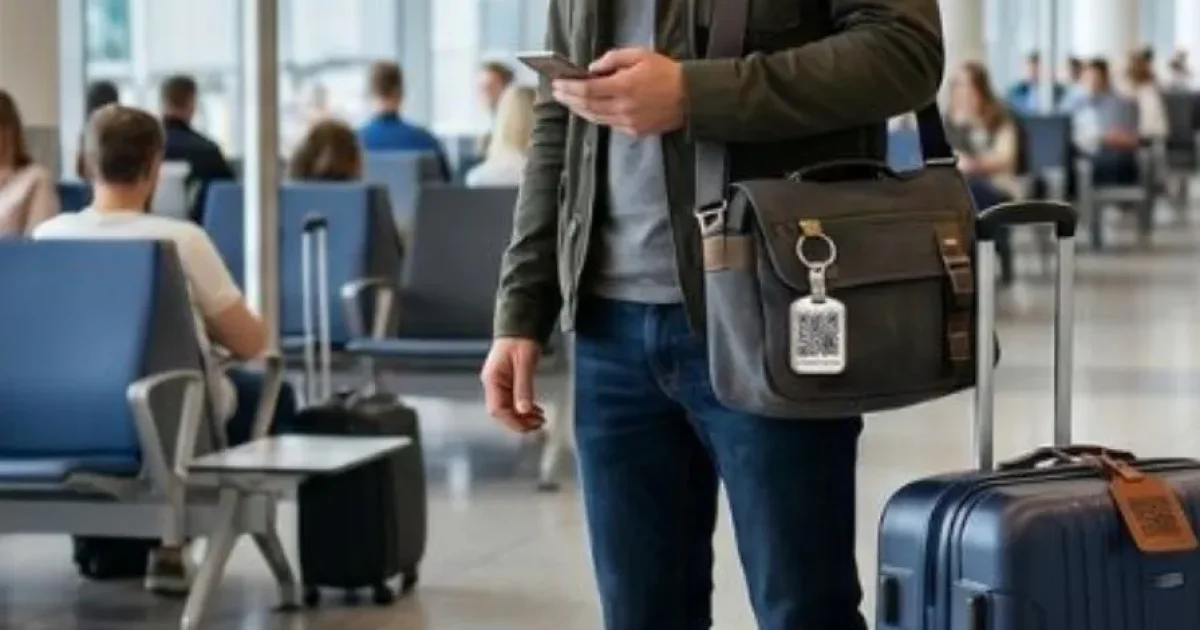
A QR-coded luggage tag is the most complete solution to the identification problem. The tag displays a QR code that any finder — a fellow passenger at the carousel, an airline baggage handler, an airport lost property officer — can scan with their smartphone to reach a contact page and send you a message. No personal information is displayed on the tag itself. You receive the notification wherever you are, reply to arrange return, and your home address has never been visible to anyone.
The Finder's Experience With a QR Tag
When a bag with a QR tag is found — whether at the wrong carousel, in a taxi, left in an overhead bin, or handed in to airport lost property — the experience for the finder is as simple as possible. They open their phone's camera, point it at the tag, follow the link, and send a brief message. They do not need an app, an account, or any technical knowledge beyond the ability to take a photo. The owner receives a notification immediately and can respond to arrange collection.
This is significantly easier than any alternative. Calling a phone number on a tag requires making an international call in some cases. Emailing an address on a tag requires manually typing it. Handing the bag to lost property starts a formal process that may take days to resolve. Scanning a QR tag takes fifteen seconds and puts the finder and the owner in direct, private communication within a minute.
For lost property offices and airline baggage teams, a QR tag provides the contact information they need without requiring them to handle the bag carefully to read a small printed address. Quick scan, message sent, owner found.
How Luggage Actually Gets Lost
Understanding how bags are mishandled helps you understand what kind of tag provides the most useful protection.
The most common cause of delayed baggage is a tight connection. A passenger who makes a connecting flight with less than 45 to 60 minutes to spare may make the gate; their bag may not. In this scenario, the bag ends up in the transfer system at the connecting airport and is typically forwarded on the next available flight. The airline knows the bag is there; reunification is usually a matter of hours or a day at most. In these cases, your booking details are the primary identifier — your luggage tag is supplementary.
A less common but more difficult scenario is a bag that is genuinely separated from its barcode record — loaded onto the wrong aircraft, ended up in the wrong sorting facility, or had its airline-issued tag torn off in handling. In this situation, the physical information on your tag — or inside your bag — is the only way an individual handler can identify who the bag belongs to. A QR tag that enables the handler to contact you directly is the most useful tool available in this scenario.
Bags left on carousels by arriving passengers who pick up the wrong bag are another scenario. This is more common than most people expect — dark hard-shell suitcases are notoriously difficult to distinguish from each other, and tired passengers sometimes grab the wrong one. A QR tag on both bags enables both the person who took the wrong bag and the person looking for their bag to make contact quickly and resolve the swap.
AirTags and Electronic Trackers in Luggage
Apple AirTags, Samsung SmartTags, and similar Bluetooth tracking devices have become popular additions to checked luggage, and for understandable reasons — knowing where your bag is in the airline's system provides real-time reassurance during a long trip, and can give you precise location data to provide to ground handlers when a bag fails to appear. Airlines have a range of policies on electronic tracking devices in luggage, and lithium battery regulations apply, so checking your carrier's current rules before travelling is worth doing.
As this comparison of QR tags and AirTags explains, the two technologies address different problems and work best together. An AirTag tells you where your bag is; a QR tag tells the person who found your bag how to reach you. In the scenario where an airline worker has your bag in a handling facility three airports away, both pieces of information are useful: you can tell them approximately where it is based on your tracker, and they can reach you via the QR tag to coordinate delivery.
Checked Luggage Versus Carry-On
The risks and requirements differ between checked bags and cabin baggage.
Checked luggage is out of your sight for the majority of your journey. It passes through handling systems, goes into the hold, and arrives — usually — on the carousel at your destination. The exposure risk from a visible home address on a checked bag is primarily at the carousel, where anyone nearby can read it. The benefit of any identification tag on a checked bag is primarily in the mishandling scenario.
Carry-on luggage stays with you throughout the journey but can be left behind, taken from an overhead bin, or set down in a hurry and forgotten. An airport is a busy environment where distraction is constant and bags are moved, stacked, and rearranged regularly. A QR tag on a carry-on bag gives anyone who finds it — another passenger, a cabin crew member, an airport staff member — an immediate route to reaching you.
Both deserve appropriate tagging. A QR tag costs nothing significant to add to multiple bags, and the benefit applies every time the bag travels — not just when something goes wrong.
Family Travel and Group Luggage
Families travelling with multiple bags face an additional complexity: distinguishing which bag belongs to which family member, and ensuring that all bags can be traced if they are separated. Standard practice — matching baggage tags on all bags with the same contact details — works adequately, but a QR tag approach improves on it in a few ways.
With QR tags, each bag can link to the same owner account or to different accounts for different family members. If a child's bag becomes separated, the finder who scans the tag reaches the parent directly rather than the child. For a large family group travelling on separate bookings, each person's bag having a QR tag that routes to their own phone number is more efficient than trying to reach each other through a chain of calls.
Identical or similar bags in a group are also easier to differentiate with distinctive tags. A bright QR tag attached in a consistent position helps family members identify their own bags quickly on a busy carousel — reducing the risk of accidentally picking up the wrong bag in the first place.
Tag Placement and Durability
Where you attach a luggage tag matters more than most people realise. Standard paper tags in plastic holders attached to a handle are the most vulnerable — the holder can snap off in rough handling, and the paper card can become illegible from water damage if the bag travels through rain or a wet cargo area. A tag that is unreadable by the time it is needed provides no benefit.
For a tag to be most useful:
- Attach it to the main handle or a reinforced attachment point, not a decorative loop or thin strap
- Use a tag made from durable material — metal, hard plastic, or high-quality silicone — rather than a card sleeve
- Consider a secondary tag attached differently, so that if one is torn off the other remains
- Place an internal identification card in the bag's pocket as a backup — this is especially important for checked bags
QR-coded tags in robust materials — particularly metal tags with laser-engraved or deep-etched QR codes — are significantly more durable than paper or printed-card alternatives. The code quality remains readable after years of handling, and there is no ink to fade or card to degrade. For a bag that travels frequently, the one-off cost of a quality QR tag pays for itself many times over compared to replacing paper tags each season.
What to Do If Your Bag Is Actually Lost
If your bag fails to arrive at the carousel, the correct procedure is well-established but worth knowing in advance so that you can act quickly without frustration.
Before leaving the baggage hall, report the missing bag to the airline's baggage desk — usually located in the arrivals hall near the carousels, or staffed by a handling agent on behalf of the airline. You will need your boarding pass, passport, and the tag receipts (the small sticker labels attached to your boarding pass when you check in — keep these throughout your journey). You will complete a Property Irregularity Report (PIR), which creates a formal record of the delayed bag and its description.
Most delayed bags are located and delivered to your destination address within 24 to 48 hours. Airlines are required under the Montreal Convention to compensate passengers for reasonable expenses incurred due to delayed baggage — typically basic clothing and toiletry purchases, with receipts required. For bags confirmed lost after 21 days, compensation for the bag and its contents is available, subject to value limits and documentation requirements.
A QR tag does not replace this formal process, but it provides a parallel informal channel. If a fellow passenger or airport worker finds your bag before it enters the formal lost property system, a QR tag may bring it back to you faster and with less bureaucracy than the official airline process.
Travel Insurance and Delayed or Lost Luggage
Most UK travel insurance policies include some cover for delayed or lost baggage, but the specific terms vary considerably between providers. Understanding what your policy covers before you travel — rather than when you are standing at a baggage desk in a foreign airport — is worth the twenty minutes it takes to read the relevant section.
Delayed baggage cover typically activates after a specified delay — often six to twelve hours — and allows a claim for essential replacement items while you wait. Keep every receipt for purchases made during the delay. The claimable amount is capped, and insurers interpret "essential" narrowly: basic clothing and toiletries are generally covered, designer replacements are not. Submit claims promptly after returning, with your Property Irregularity Report as the primary evidence document.
Lost baggage cover — for bags confirmed permanently missing rather than delayed — typically allows a claim for the bag and contents value, subject to a total cap (often £1,000 to £2,500) and per-item sub-limits. Electronics, cameras, jewellery, and sports equipment frequently have individual sub-limits considerably lower than the item's replacement value. If you travel with expensive equipment, consider specialist all-risks cover or a scheduled items endorsement for high-value belongings.
What to Pack in Your Cabin Bag Against Delays
Checked-luggage delay is manageable if you have prepared for it. A small carry-on kit — assembled before you ever check a bag — makes the difference between a minor inconvenience and a genuinely disruptive first night at your destination.
- One change of clothing. Enough for a day — prioritise whatever cannot easily be replaced at the destination, such as a specific outfit for a work event on arrival.
- Prescription medications. Any medication that cannot be safely missed or easily obtained abroad travels in your cabin bag without exception. Airlines bear no liability for the consequences of delayed medication in checked luggage.
- Phone charger and essential cables. Laptops can travel in the hold; their chargers in your cabin bag ensure a delayed bag does not leave you without power at an important moment.
- Toiletries in 100ml containers. A small wash bag complying with cabin baggage liquid rules allows normal functioning while waiting for the checked bag to arrive.
- Irreplaceable items. Documents of value, items of sentimental importance, anything that cannot be substituted if permanently lost — these belong in your cabin bag regardless of how securely tagged your checked luggage is.
Connecting Flights: The Highest-Risk Moment
If your journey includes a connection, your checked luggage faces its highest statistical risk at the transfer point. Bags must be unloaded from one aircraft, transported across the airfield or terminal, and loaded onto the next flight — all within the connection window, which on busy routes may be as little as forty-five minutes. When something goes wrong in that chain, the bag misses the connection even when the passenger makes it through.
Steps that reduce this risk: book connections of at least an hour at major hubs; check in as early as possible to give baggage more time to be correctly loaded; prefer same-airline connections where the entire journey is handled within one baggage system rather than handed between two. Make your luggage visually distinctive with a bright strap or QR tag in a clearly visible position — it helps ground handlers confirm they have the right bag when re-routing delayed items.
Budget Airlines: What Is Different
Budget carriers charge separately for checked baggage, and fees vary significantly by route, carrier, and how far in advance the baggage is added to the booking. Adding baggage at the airport is almost always substantially more expensive than adding it online before travel. Confirm your allowance and any fees before arriving at the departure airport.
Budget carriers are subject to the same EU Regulation 261/2004 framework as full-service airlines for passenger delays and cancellations, and the Montreal Convention's liability framework applies to baggage regardless of carrier type. Claims processes with some budget carriers can be more administratively demanding — keep all documentation including the PIR, submit claims promptly, and be prepared to follow up.
One counterintuitive note: budget carriers operating non-stop routes from regional airports sometimes have lower baggage mishandling rates than full-service carriers operating via hubs, because there is simply less complexity in the handling chain. A direct flight from a regional airport to a European destination does not involve a mid-journey transfer where bags can be misdirected — the scenario that produces most delays.
Hard-Shell Versus Soft-Shell: Why Visual Identification Matters More Than You Think
Hard-shell suitcases protect contents well but come in a limited palette of popular colours: black, navy, grey, and silver dominate airport carousels. If your hard-shell case is one of these common colours, the chances of another passenger picking it up by mistake — or of handlers confusing it with another bag of the same model from the same manufacturer — are meaningfully higher than they might appear.
A QR tag on the handle addresses the formal identification problem. A colourful luggage strap wrapped around the case addresses the visual differentiation problem at the carousel. Both are worth having, and they solve different parts of the same issue. For soft-shell cases, internal identification is particularly important: external tags are more likely to be torn or pulled off during heavy handling, so a card or label inside the bag ensures there is always at least one means of identification that survives the journey.
Hand Luggage, Backpacks, and Day Bags
Cabin bags and day bags deserve the same identification attention as checked luggage, and they are arguably at higher everyday risk. A backpack left at an overhead locker, forgotten on a seat in an airport departure lounge, or set down at a café during a layover is exactly the type of item that is picked up, moved, or taken without the owner noticing immediately. Unlike checked luggage, there is no airline tracking system to fall back on — once a cabin bag is gone, the formal channels for recovery are limited to lost property offices, which are inconsistently staffed and infrequently checked by travellers in a hurry.
A QR tag on the main handle of a cabin bag takes thirty seconds to attach and costs a small fraction of what any replacement contents would cost. For business travellers carrying a laptop and accessories in a cabin bag — items worth several hundred to several thousand pounds — the asymmetry between the cost of identification and the cost of loss is particularly stark.
Day bags taken on excursions at the destination are also at risk: left at beach chairs, tucked under restaurant tables, placed in a buggy basket or a pushchair net. For bags that regularly leave your immediate possession, a QR tag on the outer handle is the minimum sensible identification. A card inside the main pocket with a name, email address, and mobile number adds a second layer for the finder who opens the bag rather than scanning the tag.
The Return Journey: A Different Set of Risks
Most luggage advice focuses on the outbound journey, but the return leg carries its own risks. Packing after a holiday is typically rushed — extra items purchased at the destination, dirty laundry stuffed in, the general disorder of ending a trip. Tags that were securely attached at the start of the holiday may have been removed, damaged, or lost during the trip itself. A baggage tag that was fine for the outbound flight may be hanging by a thread on the return.
Before leaving for the airport at the end of a trip, quickly check that all identification tags — both QR tags and paper airline tags — are still securely attached to each piece of luggage. Add a new airline tag at check-in as normal, and confirm that your QR tag is still in place on the handle. This thirty-second check before departing the hotel is the most underused step in travel luggage management, and it closes the gap that causes otherwise well-prepared travellers to lose bags on the journey home.
Travel Smart, Travel Light on Privacy
The perfect luggage setup for summer travel involves layers: a QR tag on the outside of each bag, an internal name-and-email card inside each bag, an electronic tracker in your checked suitcase if you choose, and your booking reference kept accessible on your phone. That combination provides maximum recoverable information to multiple different types of finder — airline handlers, fellow passengers, lost property offices — without broadcasting your home address to every person who passes your carousel.
As this earlier article explains in full, the home address on a traditional luggage tag was never the right piece of information — it was simply the only one people thought to write down. A QR tag replaces that habit with something that works better, costs nothing significant to implement, and does not tell strangers that your house is empty for a fortnight.
If you are travelling this summer and would like to tag your bags properly before you go, browse HeyOwner's QR travel and luggage tags here. Each tag links to a private contact page that any finder can reach with a standard smartphone camera, worldwide, with no app and no account required on their end. Your bags can find their way back to you — without your home address finding its way anywhere it should not.